Ivysaur 4-4-8 in DropSet: a weekly climb, an earned double, and a deload
Almost every beginner program adds weight session by session. Ivysaur 4-4-8 doesn't — it adds weight once per program week, and it hands you a way to earn more. The heavy top set of each lift is an AMRAP: you rep it out, and if you clear eight or more, that week's jump doubles. It's the only program in the catalogue that progresses on a weekly cadence, so the number worth following isn't the workout, it's the week.
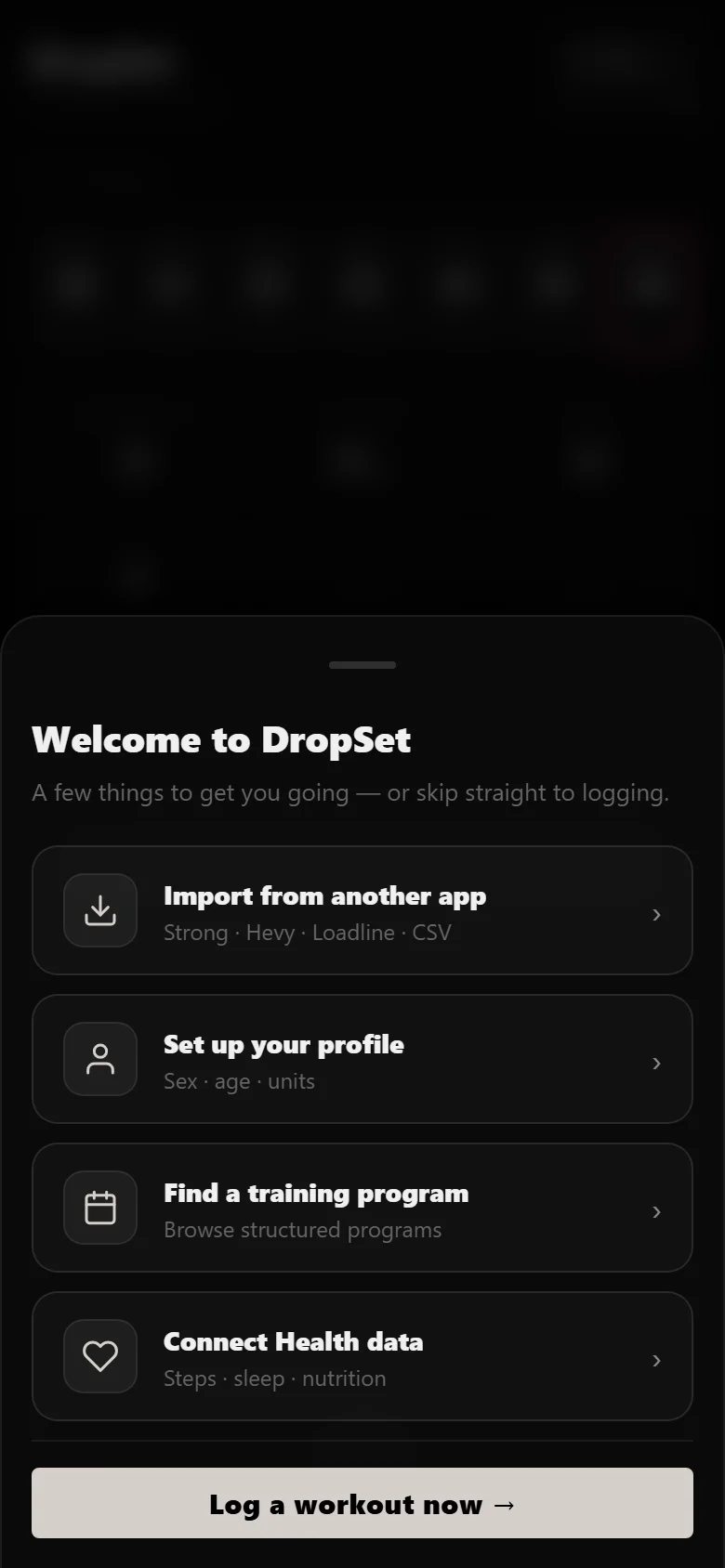
This is a true beginner's eleven-week run, followed on the squat. It opens at 40 kg, climbs a whole week at a time, doubles its jump twice off big rep-outs, stalls hard at 100 kg across two full weeks, gets deloaded 10% by the app, and rebuilds straight through the ceiling to finish with 105 kg on the bar. Nothing after the first week was typed in. Every figure below is what the real engine recorded on the drive.
An A/B fortnight, and one working weight per lift
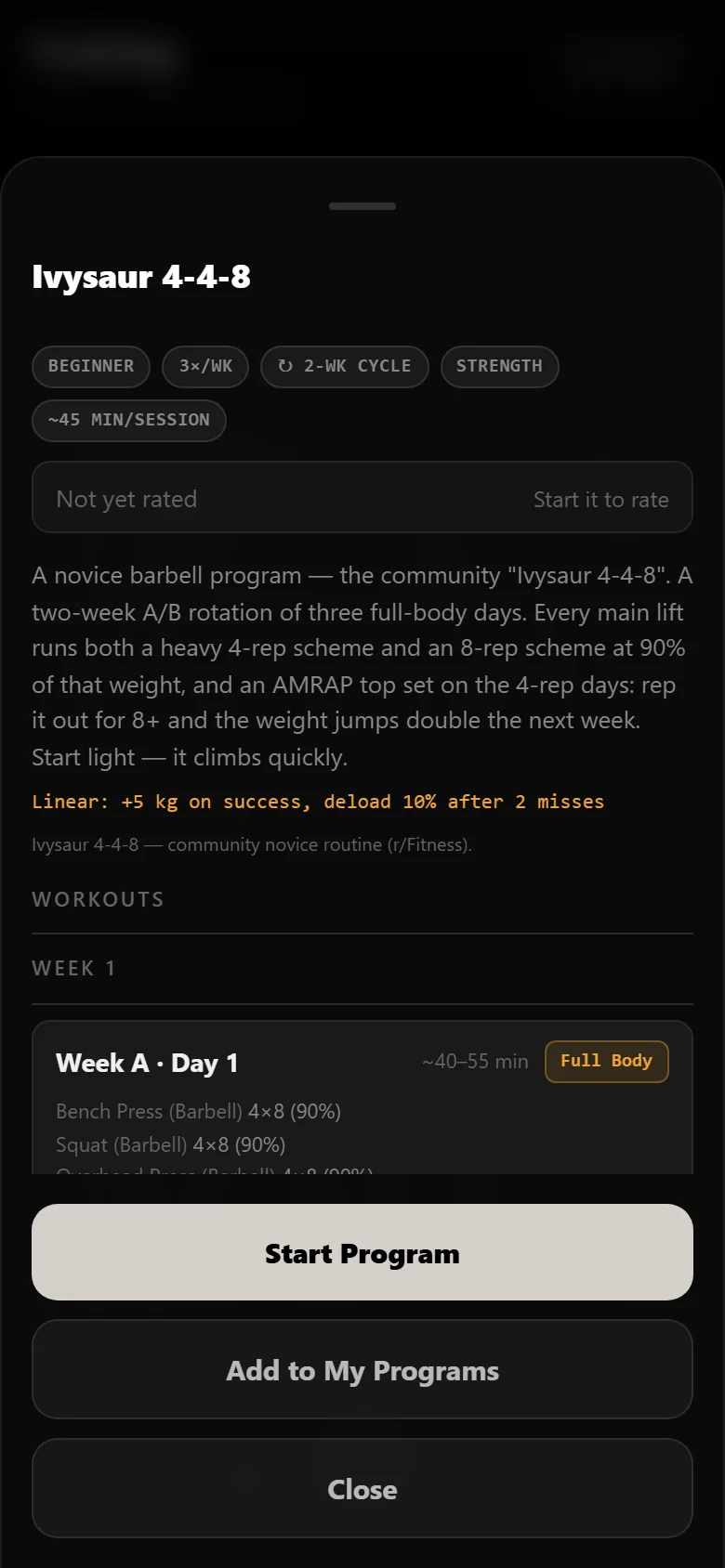
Ivysaur runs a two-week A/B rotation, three sessions a week. Week A is one set of workouts, Week B another, and they alternate for as long as you run the program. Every session mixes rep schemes — that's the "4-4-8": heavy sets of four, a heavy set of four that finishes on an AMRAP, and lighter volume sets of eight. The squat trains three times across the fortnight: two back-off days of eights at 90% of the top-set weight, and once each fortnight a heavy day where the last set of four is taken all-out.
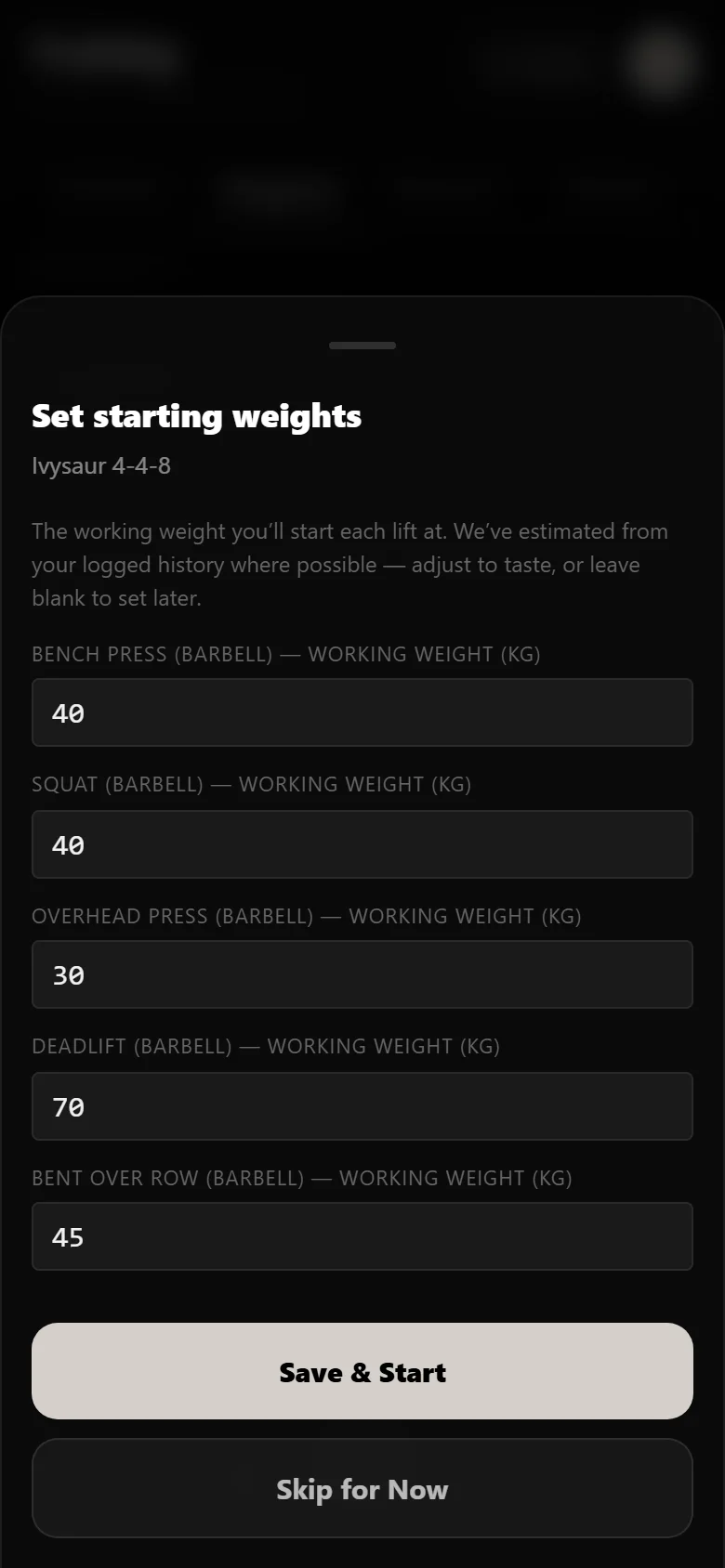
There are no training maxes and no percentages to work out. Ivysaur asks for a working weight per lift and starts you there — 40 kg on the squat here. Start conservatively: a weekly climb of 7.5 kg on the squat is fast, and the AMRAP double is faster still, so the room to grow is the whole point.
The climb — a whole week at a time, decided for you
Squat opens at 40 kg. Complete the week's prescribed squat work and the app adds 7.5 kg — but not until the week is done. This is the difference that trips other trackers up: on Ivysaur the weight doesn't move between your Monday and Friday squats, it moves between one program week and the next. You train the same weight all week, then the app steps it up.
The chip beside the exercise name shows the rule while you train, so you can see the lift is on a weekly linear jump rather than a per-session one. Each lift climbs at its own rate: the squat and deadlift add 7.5 kg a week, the bench 5 kg, the overhead press 2.5 kg — the bigger lifts earn the bigger weekly jumps, and you configure none of it.
The catalogue counts this program by the week, and so does this article. Week 1 is 40 kg. Complete it and Week 2 is heavier — how much heavier is the interesting part.
The AMRAP double — the top set that pays extra
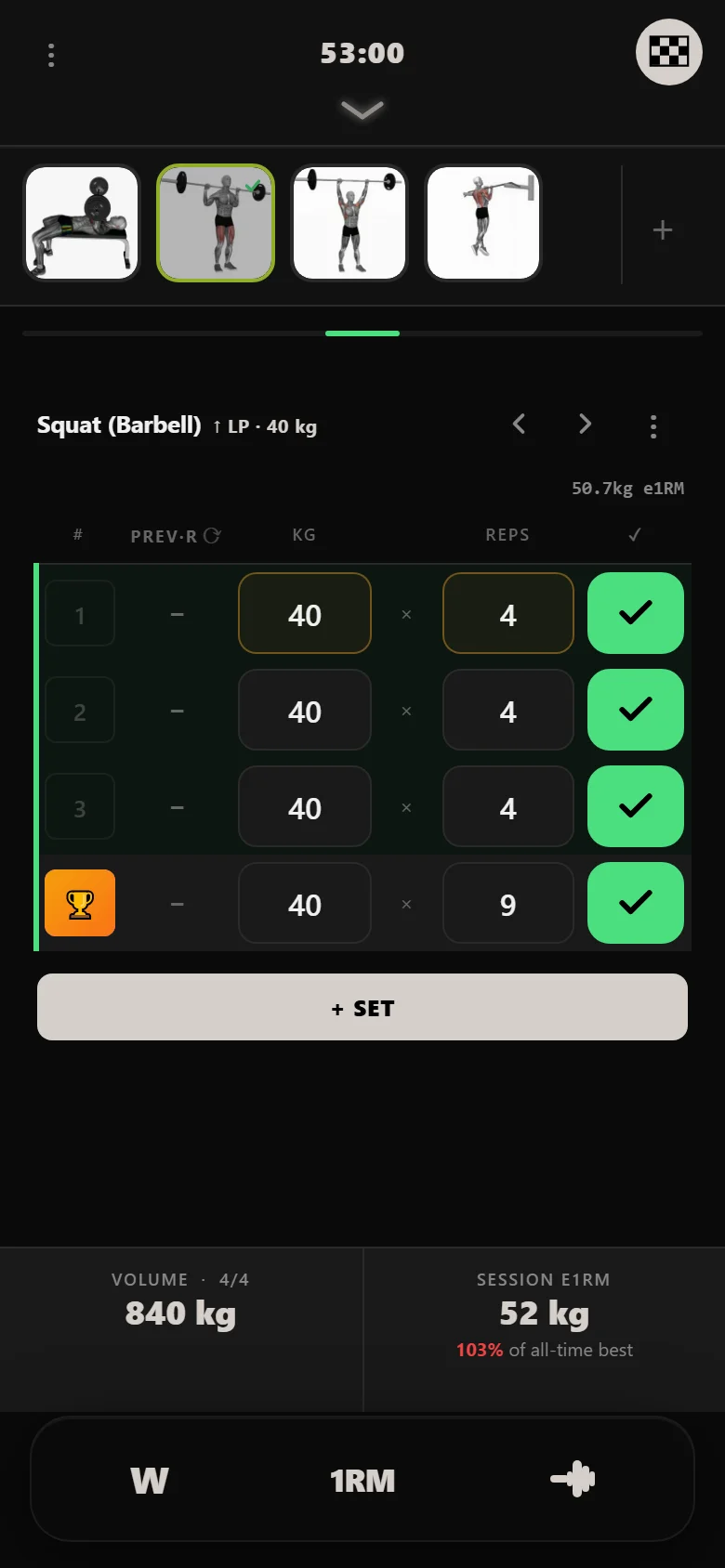
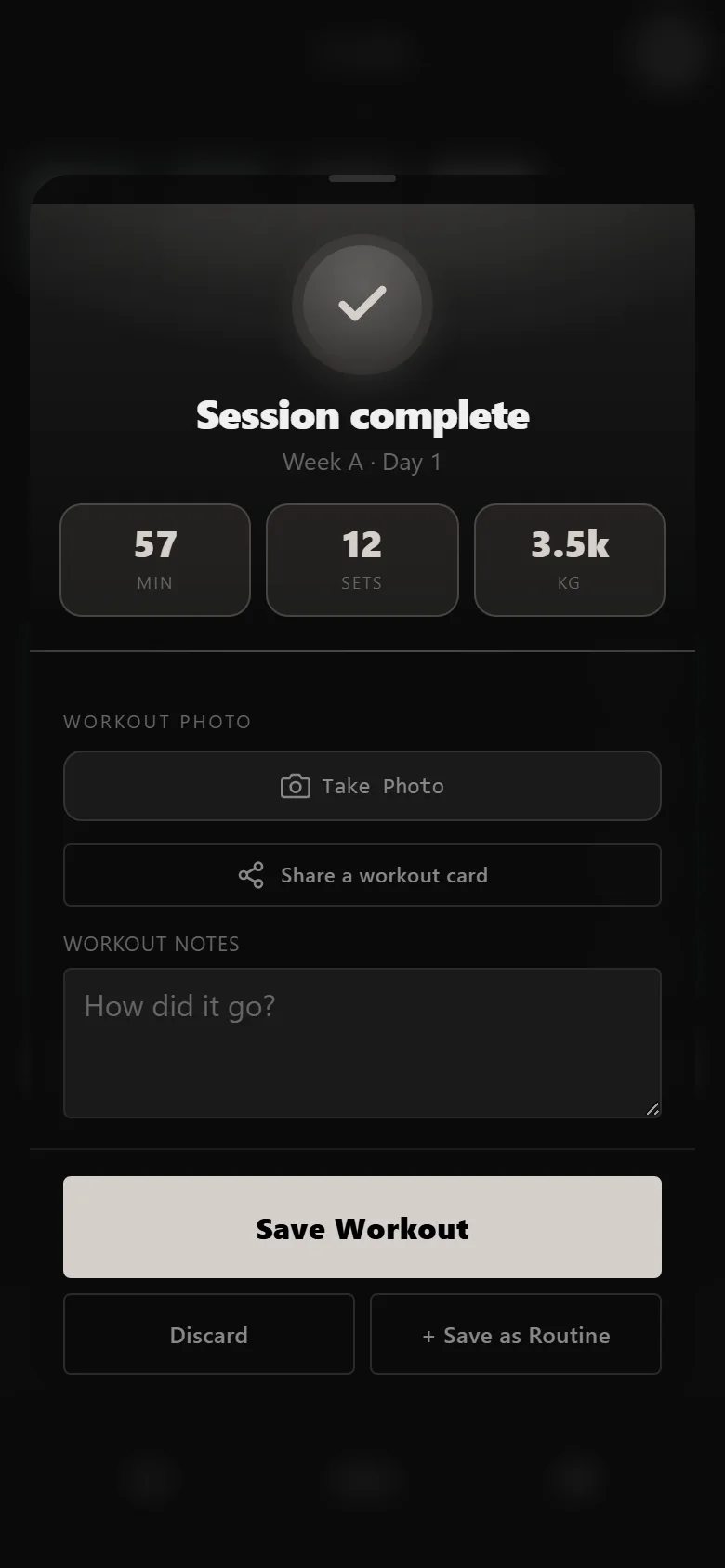
The heavy squat day finishes on an AMRAP: the last work set is taken for as many reps as you can. This is where Ivysaur rewards a good week. Rep out eight or more on that top set and the weekly jump doubles — instead of 7.5 kg, the squat goes up 15 kg for the following week.
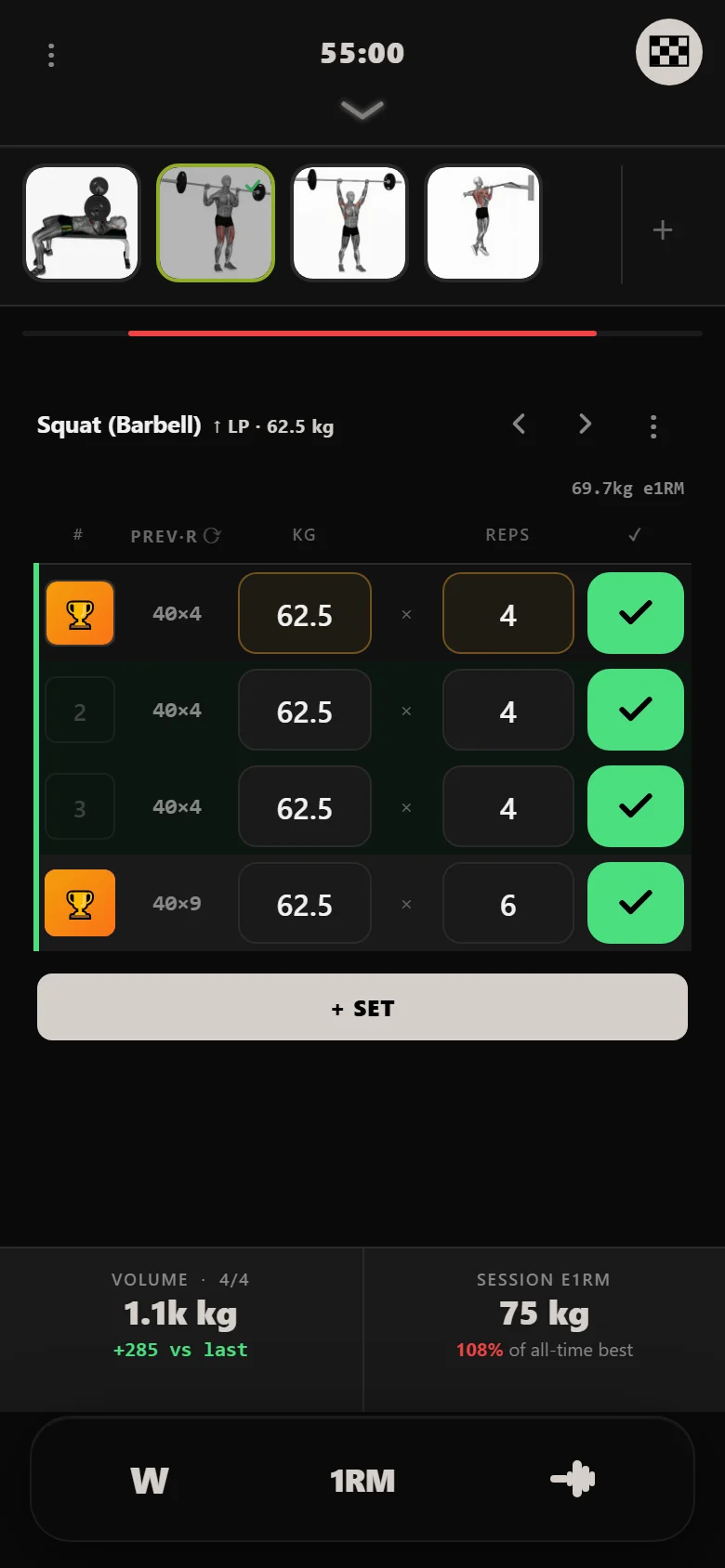
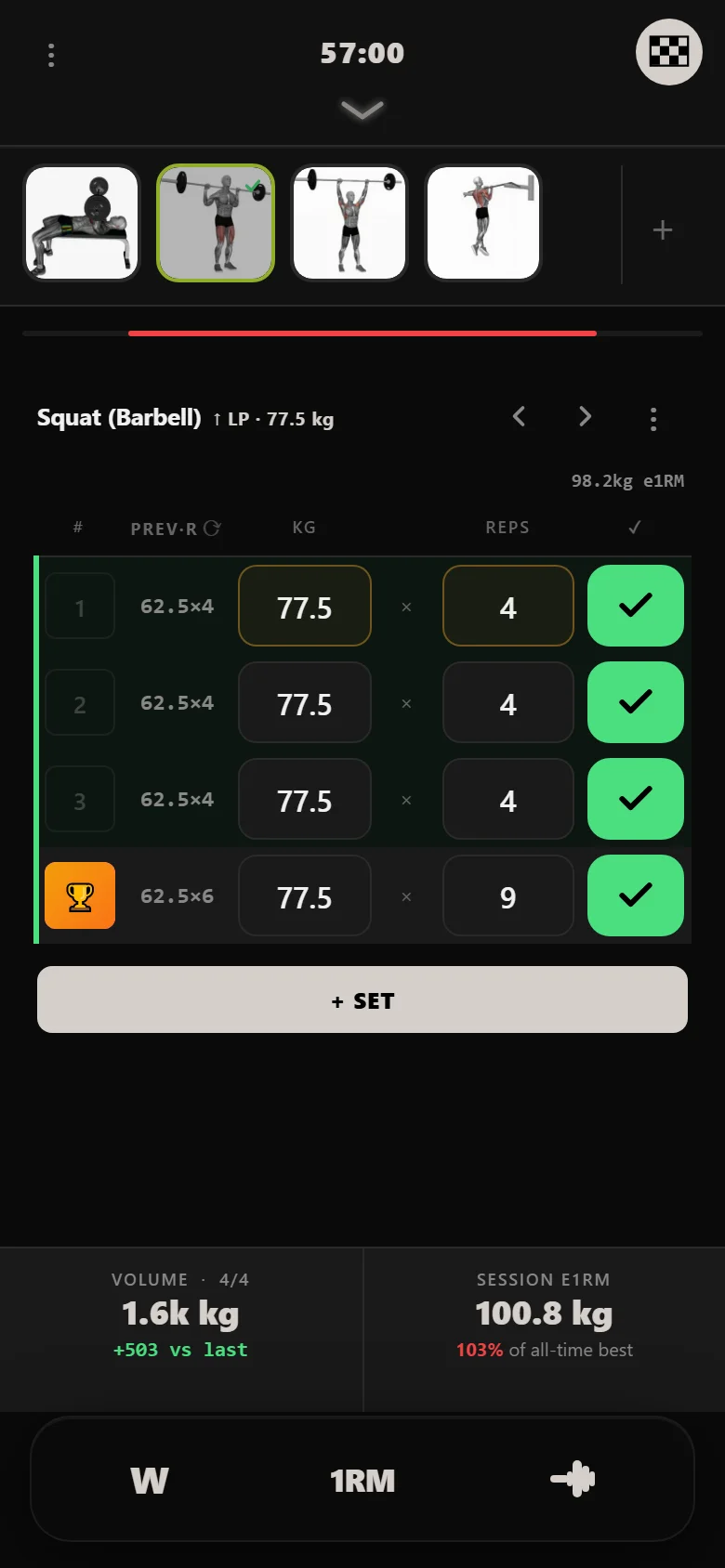
It happened twice on this run. Week 1's top set went for nine reps, so Week 2 opened not at 47.5 kg but at 55 kg — the standard jump doubled, off a single hard set. It happened again on the heavy day in Week 5: another nine-rep top set at 77.5 kg, and the squat leapt to 92.5 kg the following week. That 15 kg jump is the one that eventually bit — but that's the method working, not failing, and the stall is next.
The double is a bonus, not a default. On the weeks the top set fell short of eight — six reps in Weeks 3 and 11 here — the squat still climbed, just the standard 7.5 kg. That's most weeks: the steady weekly jump is the rule, the double is what you earn when you have a great set in you. The app reads the reps you logged on the top set and decides which one you get.
The stall — a whole week that doesn't go up
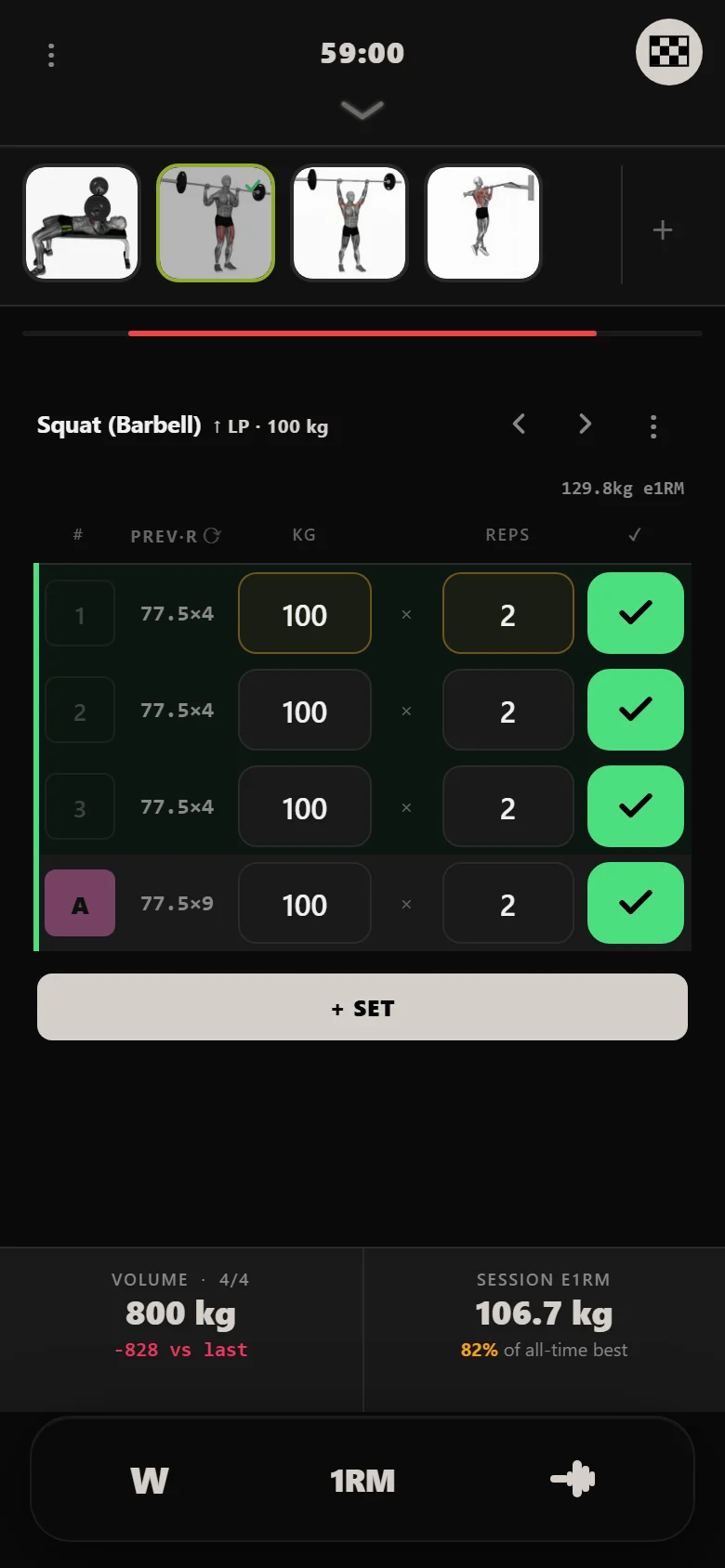
At 100 kg the climb stops. The prescribed reps come up short across the week's squat work — a genuinely failed week — and the obvious mistake for an app is to see one completed heavy set and add weight anyway.
DropSet holds. The squat stays at 100 kg into the next program week, because the target wasn't met and nothing advances on a week you didn't complete. On a weekly-cadence program a stall is a whole week where the number doesn't move, not a single bad session — miss the work and the app leaves the weight exactly where it was.
Then it happened again. A second week at 100, a second week of missed reps. Two failed weeks in a row on the same lift is the program's cue to act, and the app was watching for it.
The deload — the app backs you off
Two missed weeks in a row trips the rule, and the app drops the squat by 10% — 100 kg becomes 90 kg — then restarts the weekly climb from there. You didn't decide that, calculate it, or remember to do it. Ivysaur specifies a deload after two failed weeks and the engine applied one.
Here's the part people get wrong about deloading: it isn't lost ground, it's a run-up. Eleven weeks of squatting look like this — five weeks of climbing, two of them doubled off a rep-out, two flat weeks where the weight held at 100, one 10% cut, and then a rebuild that carries you straight back through the weight that stopped you. From 90 the squat climbs to 97.5, then 105 — past the 100 that stalled it, and squatted on the heavy day, not just prescribed.
Squat — weight on the bar, per program week (weekly cadence)
- 40W1 Week 1 — opener — top set repped 9, double
- 55W2 Week 2 — double landed: +15 kg off the rep-out
- 62.5W3 Week 3 — top set 6 — standard +7.5
- 70W4 Week 4
- 77.5W5 Week 5 — top set repped 9 — double
- 92.5W6 Week 6 — the second double landed here
- 100W7 Week 7 — the climb bites — missed, held
- 100W8 Week 8 — second miss trips the deload
- 90W9 Week 9 — −10% applied automatically
- 97.5W10 Week 10
- 105W11 Week 11 — past the 100 that stalled it — on the bar
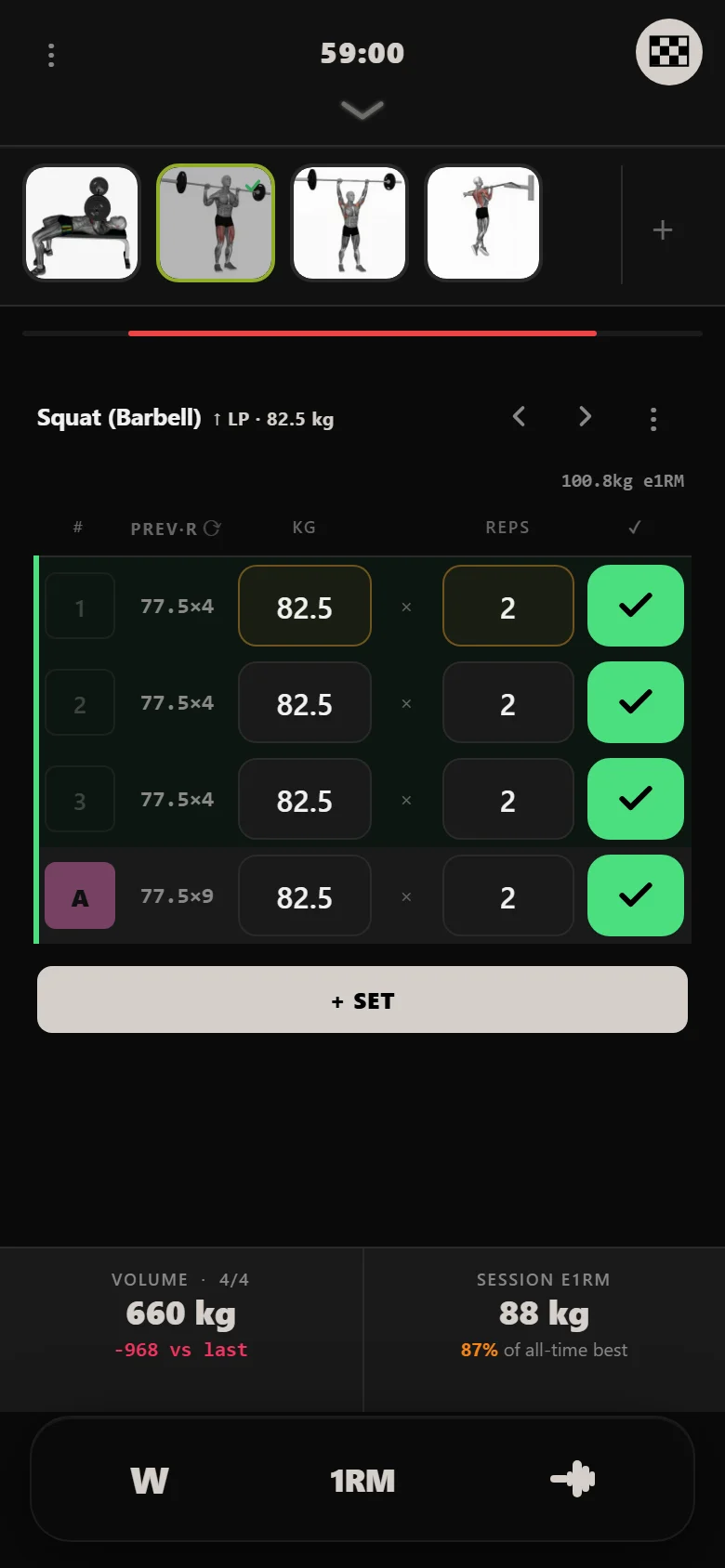
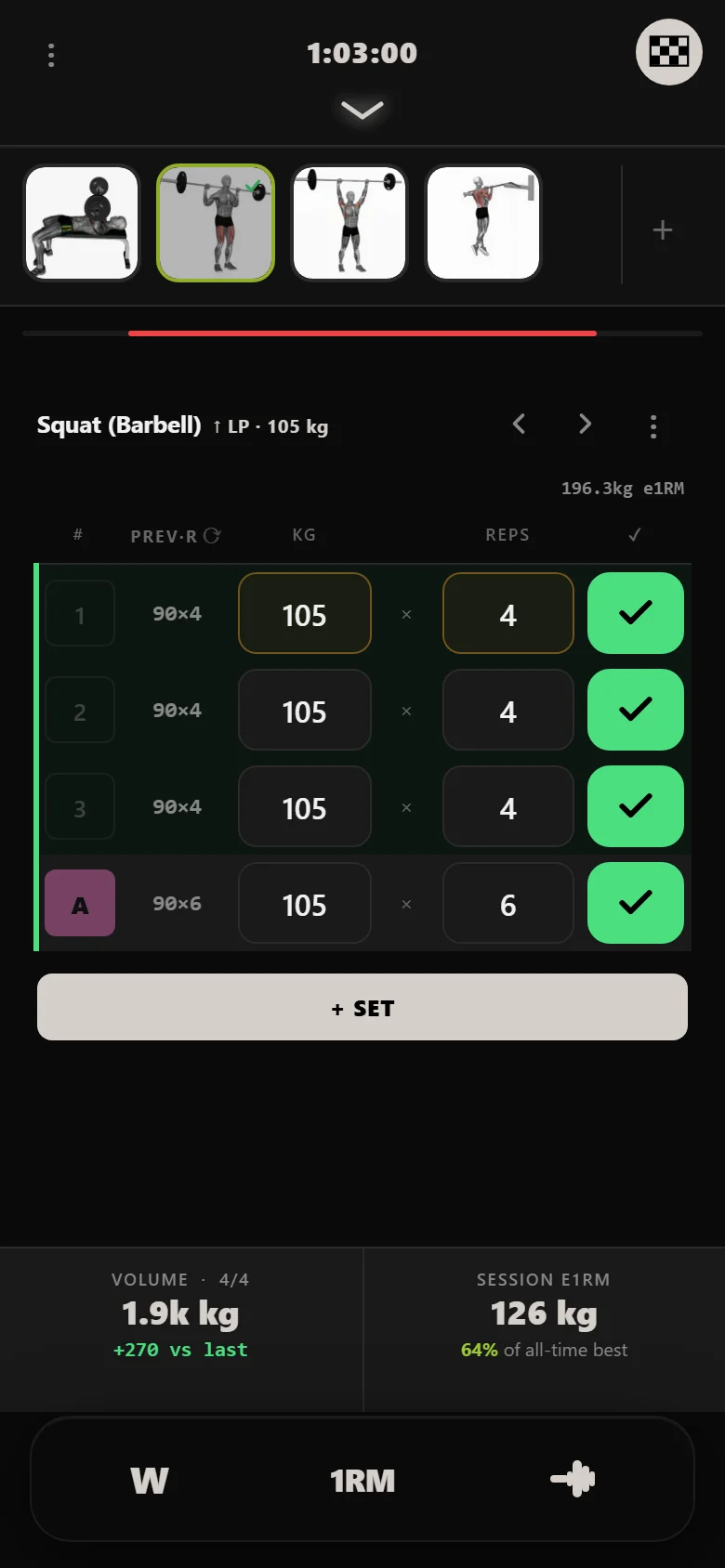
What it looks like afterwards
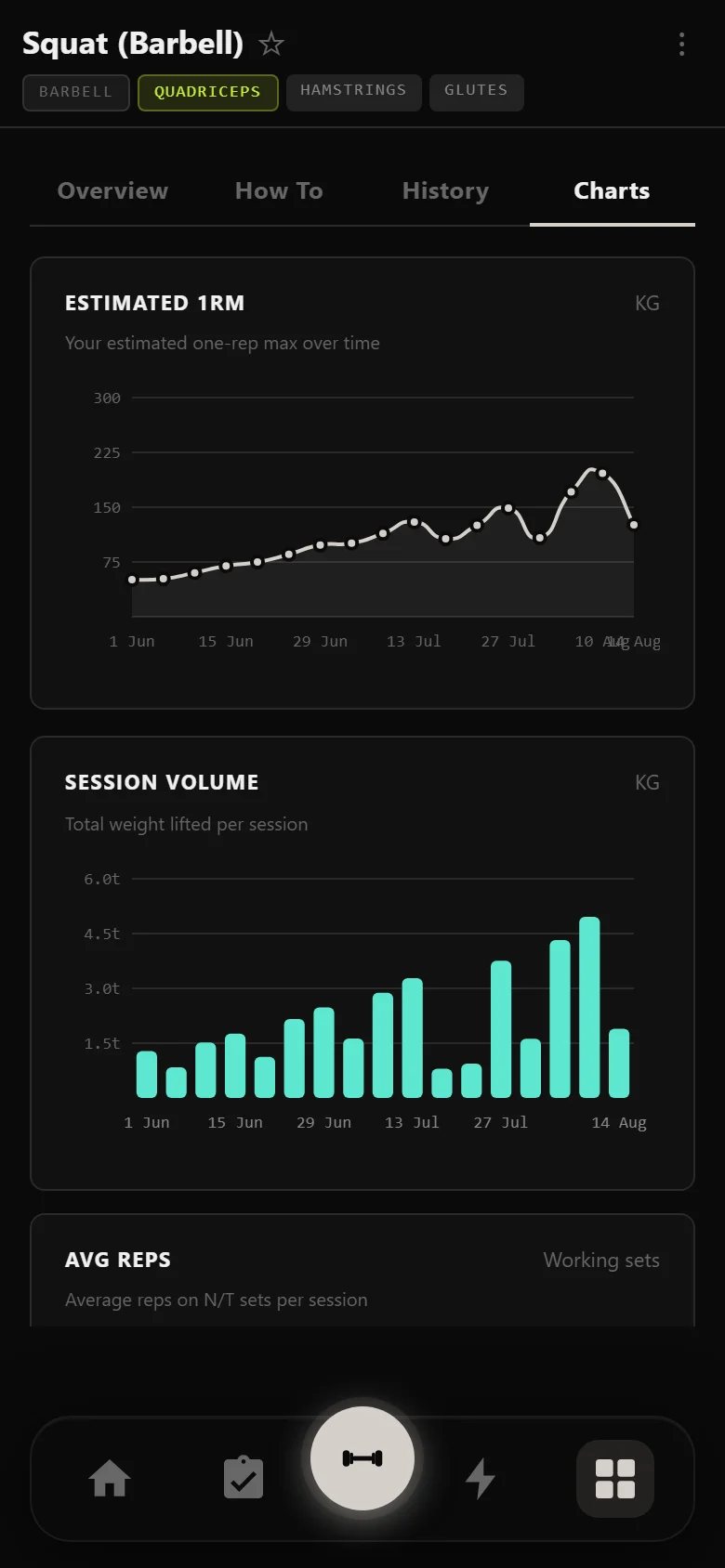
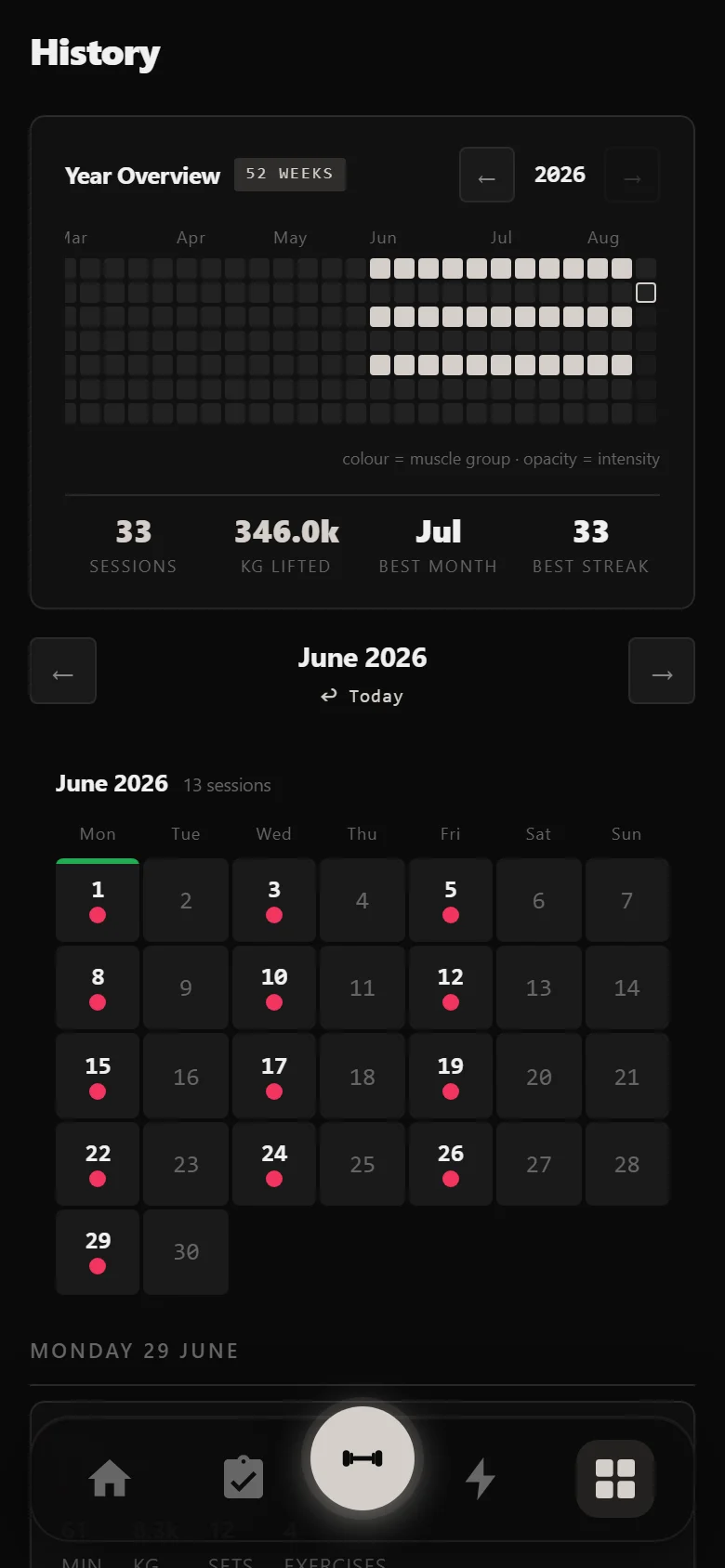
Eleven weeks of three sessions fill the History calendar from the start date, and the squat's own Estimated 1RM chart draws the shape of the block: a steep early climb with two jumps where the doubles landed, a flat stretch where the weight held at 100, the dip at the deload, then a climb back through the old ceiling. That shape is what a weekly-cadence beginner run actually looks like once you train long enough to stall — the honest picture, not a line that only goes up.
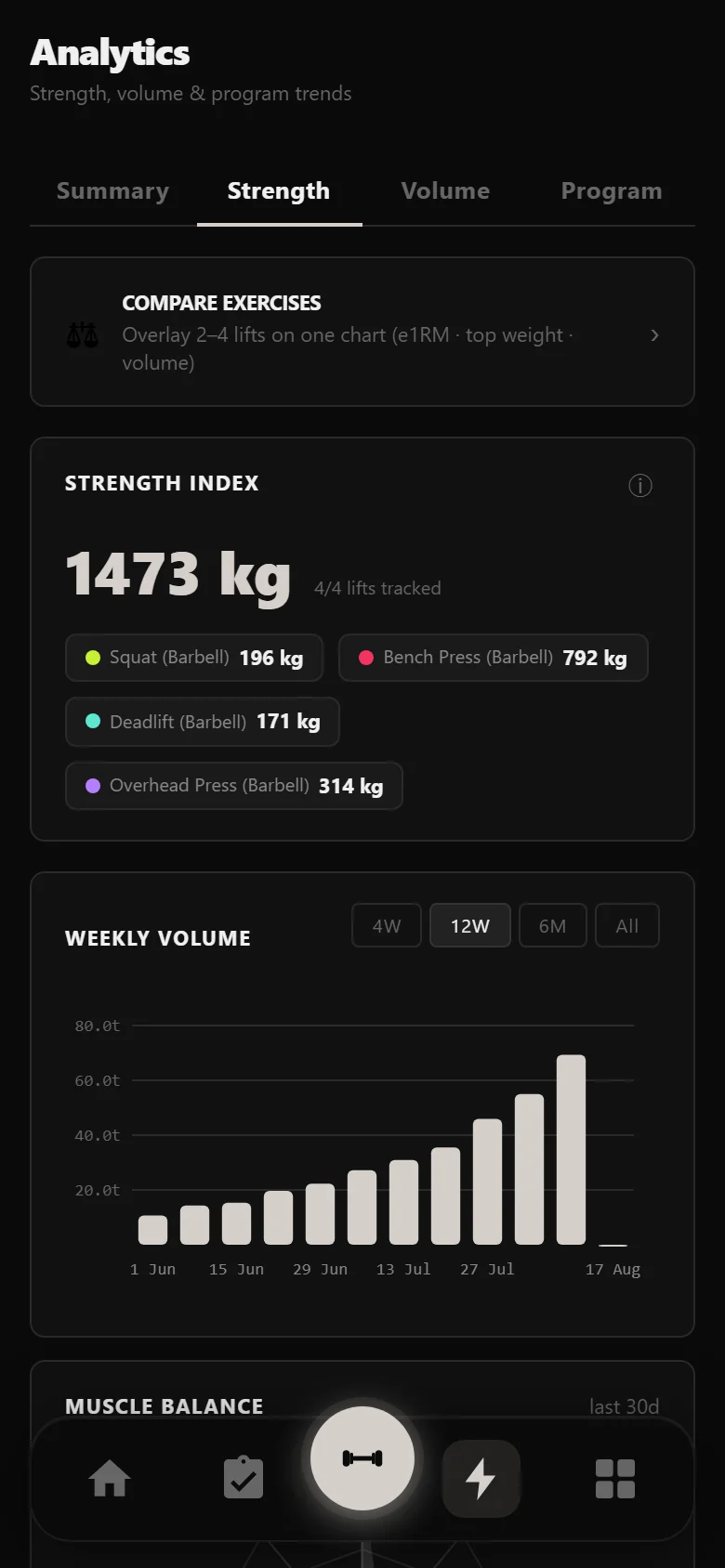
The strength view tells the same story per lift, and the highs are logged as PRs as they happen. Eleven weeks of training, no spreadsheet, no arithmetic — the app decided every weight from the reps you logged.
The payoff — where the squat started and finished
Two screenshots of the same heavy squat day, eleven weeks apart: the same lift, the same screen. Week one opened at 40 kg; the later shot has 105 kg on the bar — after two earned doubles, a two-week stall at 100 kg, an automatic deload to 90, and a rebuild straight back through the ceiling. Nothing in between was typed in — every weight was decided by the engine from the sets that were logged, one program week at a time. That is the case for the app in one screen.
Same squat, eleven weeks apart — 40 kg opener to 105 kg on the bar. Two earned doubles, a two-week stall and the deload are in between, and the app drove every weight, one week at a time.
Common questions
What is Ivysaur 4-4-8?
A novice barbell program that progresses on a weekly cadence rather than session to session. Each session mixes rep schemes — heavy sets of four and lighter sets of eight, hence "4-4-8" — and the heavy top set of each lift is an AMRAP. It runs a two-week A/B rotation, three sessions a week, and adds weight once per program week.
How is the progression different from other beginner programs?
Most beginner programs add weight every session. Ivysaur adds it every WEEK: the bar stays the same across a program week and steps up between weeks. It's the only program in the catalogue that progresses weekly, so you follow the week, not the workout. DropSet handles the cadence for you — it waits for the week to complete before it moves the weight.
What is the AMRAP double?
The heavy top set of each lift is taken for as many reps as you can. Rep out eight or more and that week's weight jump doubles — the squat goes up 15 kg instead of 7.5 kg. It's a bonus you earn on a big set, not something that happens automatically; on weeks the top set falls short of eight, the lift still climbs by the standard weekly amount.
What are the back-off sets at 90%?
The squat's two lighter days each fortnight are sets of eight at 90% of the four-rep working weight — volume that isn't the all-out top set. The heavy day is where the four-rep sets and the AMRAP live, and it's the heavy day's top set that drives the weekly jump and the double. The 90% is a starting estimate; the program's author ran the back-off work nearer 80–85%, and you can adjust it.
How much does each lift go up?
Per program week: the squat and deadlift add 7.5 kg, the bench 5 kg, the overhead press 2.5 kg — and each of those doubles the week the top set reps out eight or more. The bigger lifts earn the bigger jumps. You don't set any of this; each lift carries its own rule and the app applies it.
What counts as a failed week?
Missing the rep target on the week's working sets. Because the cadence is weekly, a stall is a whole week where the weight doesn't move, not a single bad session. DropSet holds the weight rather than adding to it, and it judges the work you actually logged — one completed heavy set doesn't earn a jump on a week you didn't finish.
What happens when I stall?
The weight stays where it is. Miss the number of weeks the program specifies in a row — two, here — and DropSet reduces the weight by the deload percentage the program specifies (10%) and the weekly climb restarts from there. You don't have to notice the stall or work out the new number.
Isn't a deload going backwards?
Only if you stop. The reduced weight is a run-up: you climb back through the weight that stalled you with a couple more weeks of training behind you. In this block the squat stalled at 100 kg, deloaded to 90 kg, and finished with 105 kg on the bar — above the ceiling that beat it.
Is DropSet free?
Yes — DropSet is free during beta, with the full program catalogue, automatic progression maths, rest timers and PR tracking. Everything in this walkthrough is in the app.
Put it into practice
DropSet is free during beta — 50 proven programs, automatic progression, rest timers and PR tracking, all on your phone.