5×5 in DropSet: the climb, the stall, and the comeback
Most program walkthroughs show you the good weeks. This one doesn't. A 5×5 linear progression is the simplest thing in strength training — add a little weight every session until you can't — and the whole point is what happens when you can't. So this run misses. Three sessions in a row, on purpose, to show you exactly what the app does about it.
The numbers are a true beginner's: a 40 kg squat, a 40 kg bench, six weeks of training. That's who runs a linear progression, and it's the only honest way to show one. Every screen below is the live app and every weight, rep and estimate is computed by the real engine.
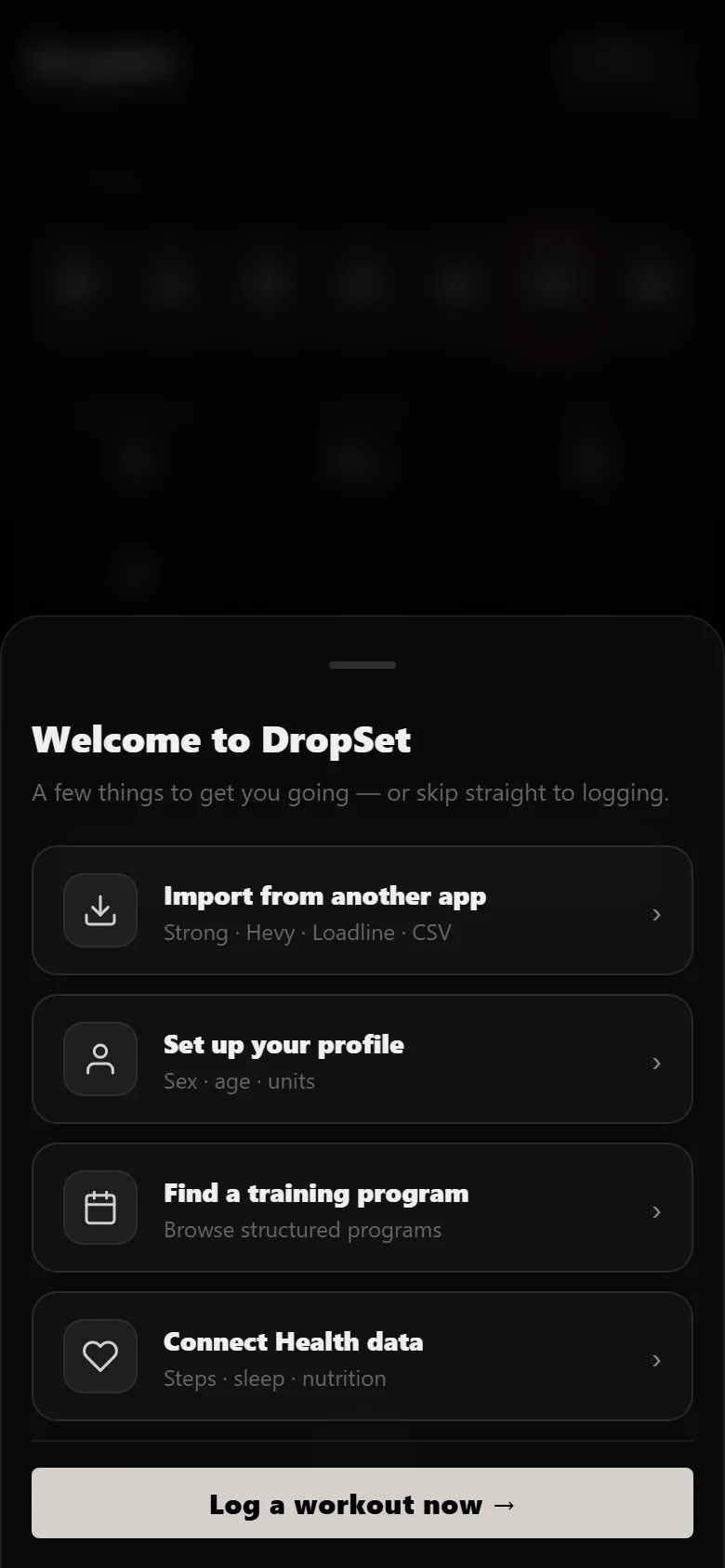
Starting the program
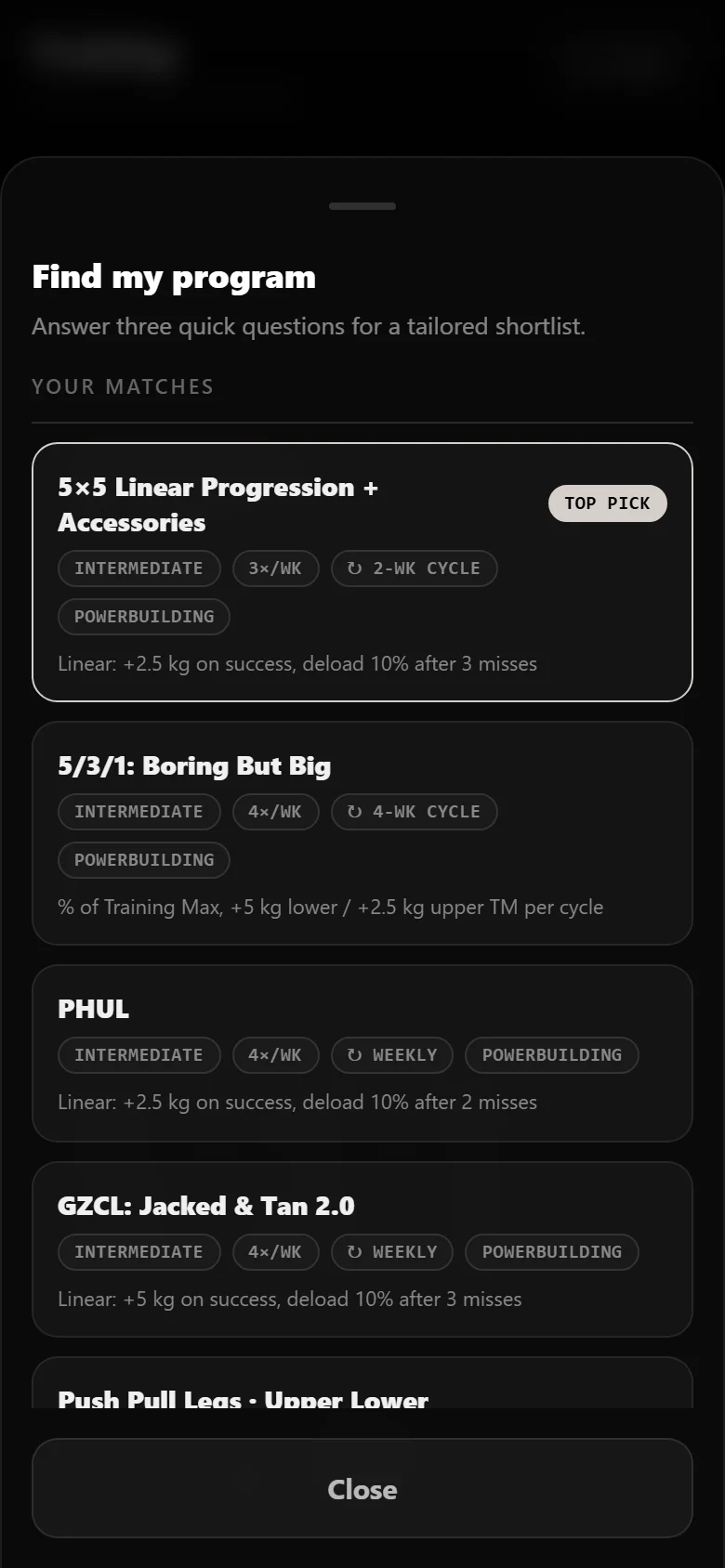
The finder asks three questions — goal, experience, days per week — and returns a shortlist. This program pairs five compound lifts on straight 5×5 with a handful of accessories for size.
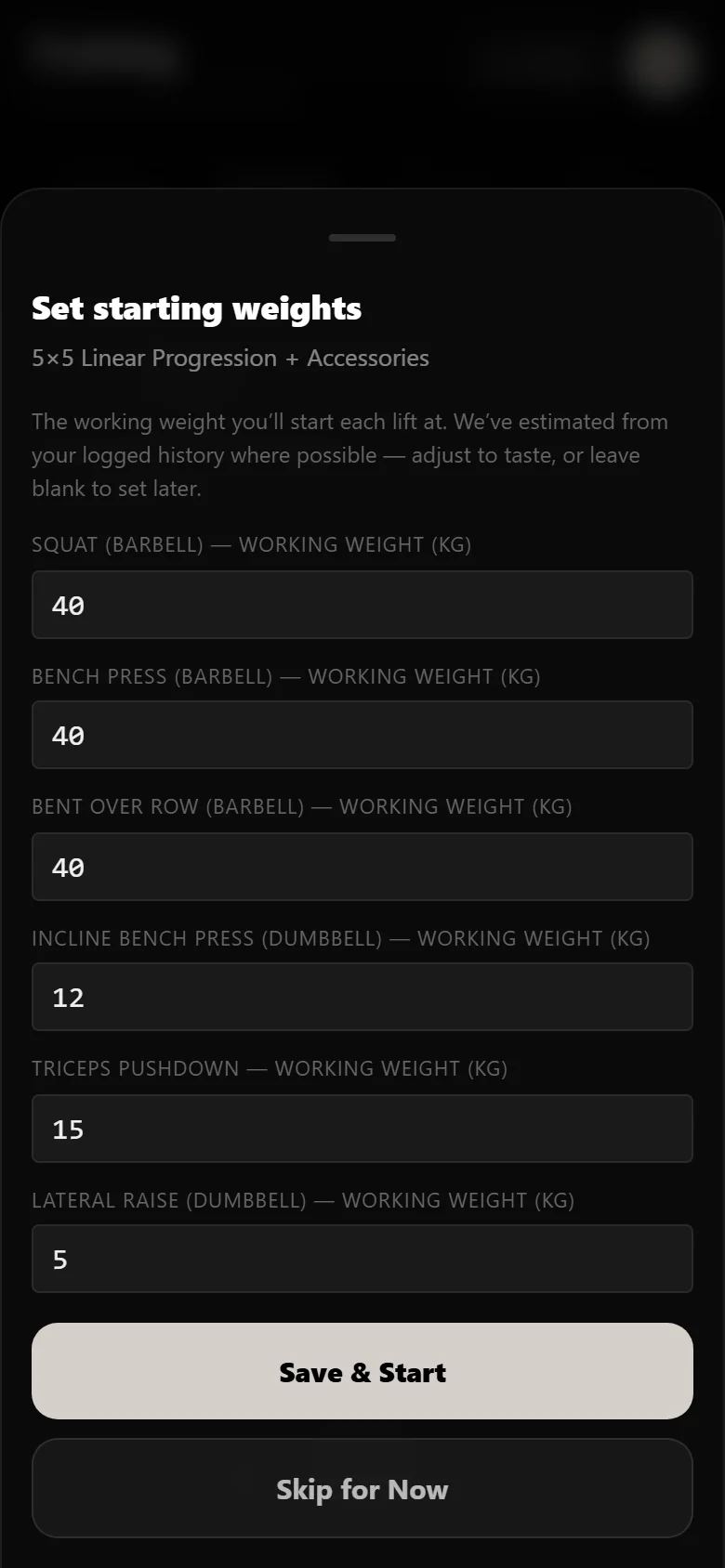
There are no training maxes to work out. Linear progression runs off a working weight per lift, so the app asks what you can currently do for five solid sets and starts there — 40 kg on the squat here. Start conservatively: the whole method depends on having room to add weight for months, and the app adds it for you every session.
Two sessions alternate. Workout A is squat, bench and row; Workout B is squat, overhead press and deadlift. Training three days a week you get A-B-A one week and B-A-B the next, so each workout comes round three times a fortnight. You squat in every single session — which is why the squat is the lift worth following through this article, and why the numbers below count sessions, not weeks.
The climb — 2.5 kg a session, decided for you
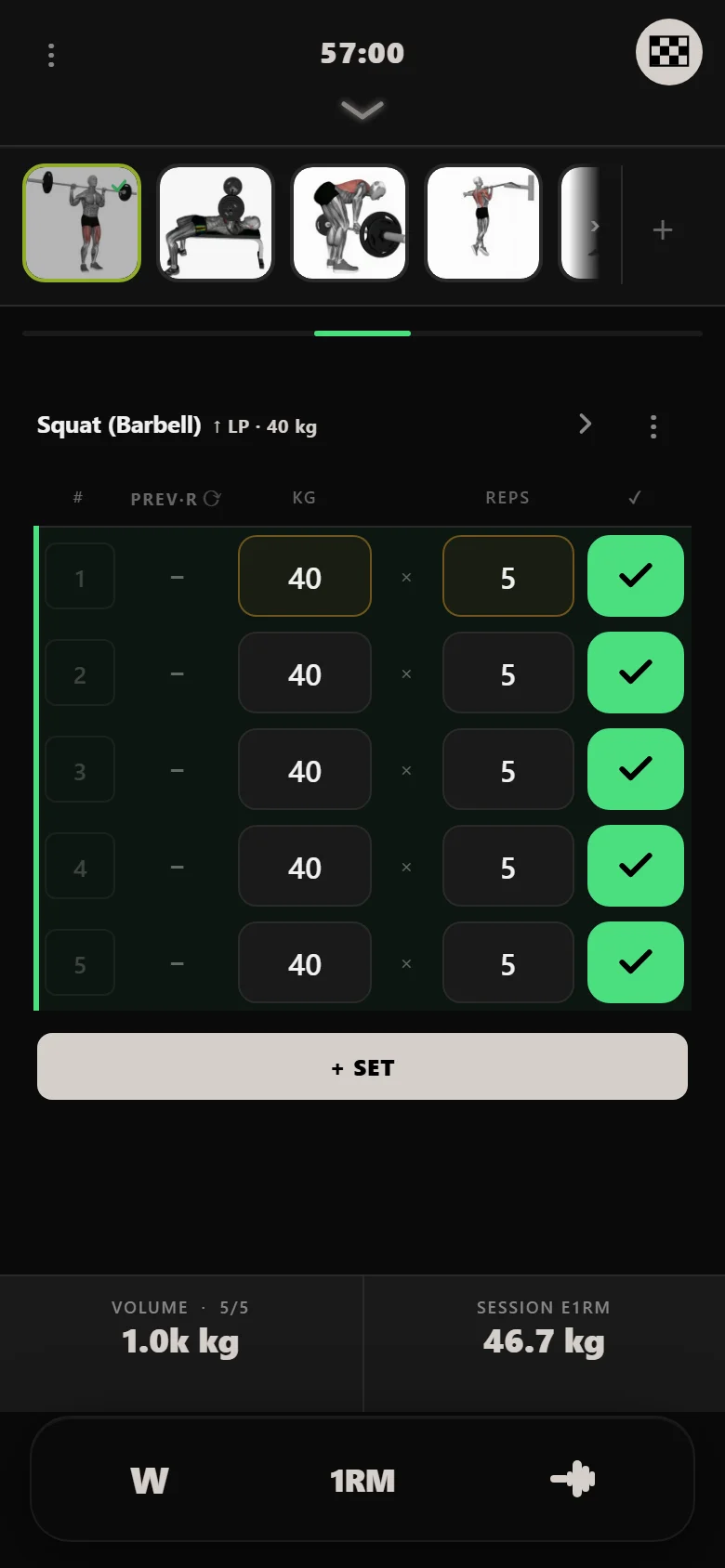
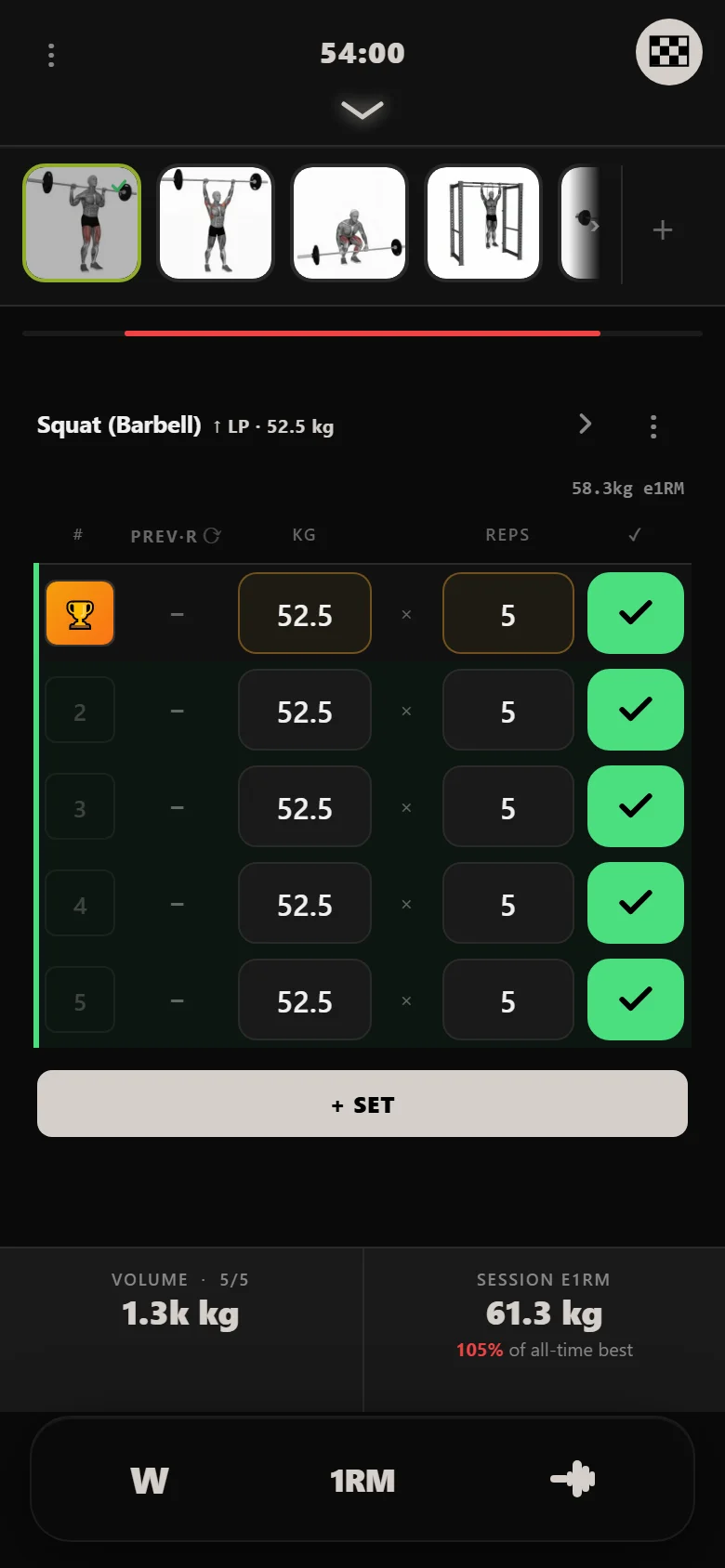
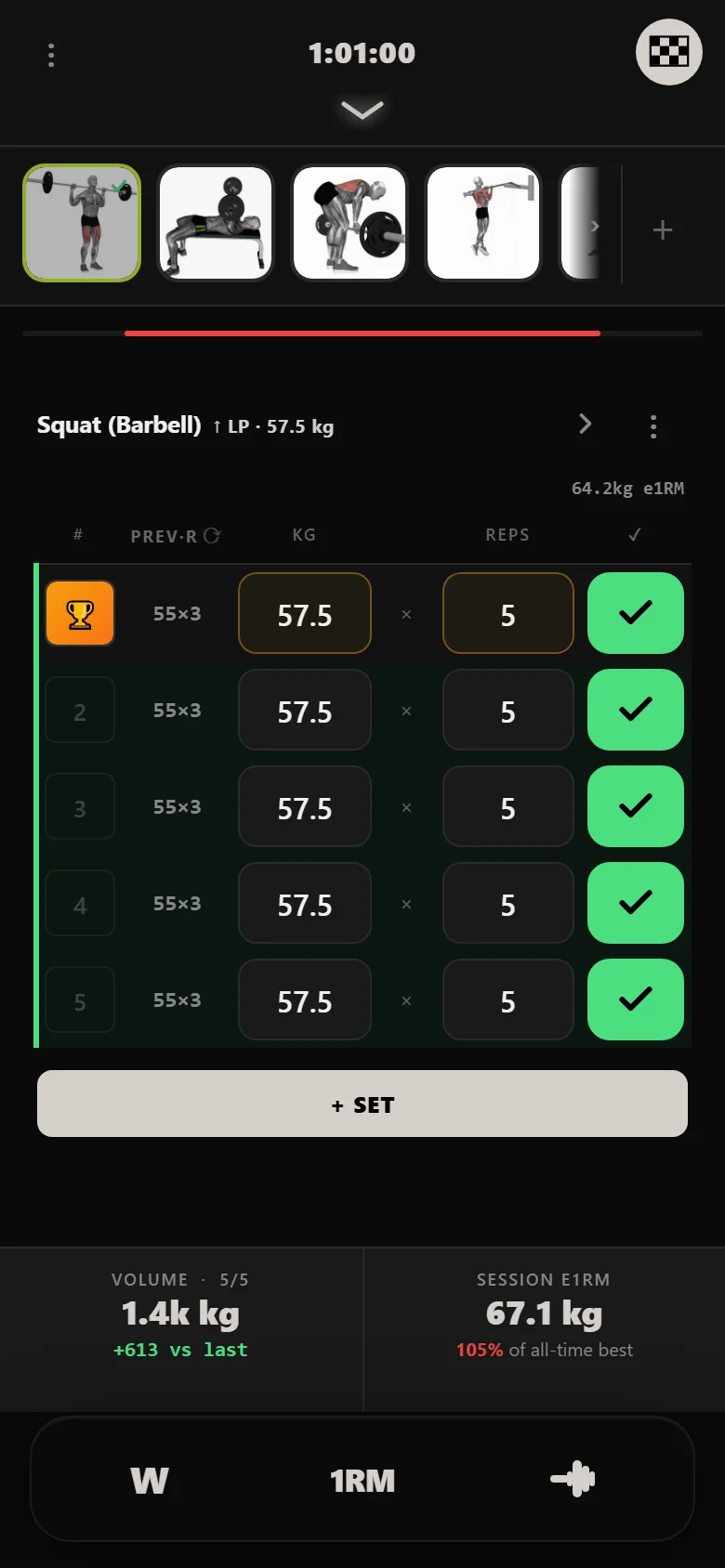
Squat opens at 40 kg for five sets of five. Complete all five sets at five reps and the app adds 2.5 kg to the next session. You don't tell it you succeeded and you don't do the arithmetic — it reads the sets you logged and moves the weight.
The chip beside the exercise name reads "↑ LP · 52.5 kg", so the rule governing the lift is visible while you're training rather than buried in a settings screen. Six sessions in, squat has gone up 2.5 kg every single time. The PREV column shows what you did last session, so you turn up and the weight is already on the screen.
Not every lift moves at the same rate, and the app doesn't pretend otherwise. Squat, bench, row and overhead press all run 5×5 at 2.5 kg a session. The deadlift runs a single set of five and goes up 5 kg — it's the heaviest lift and the one that takes most out of you, so it earns less volume and a bigger jump. Each lift carries its own rule; you don't configure any of it.
The stall — three sessions that don't go up
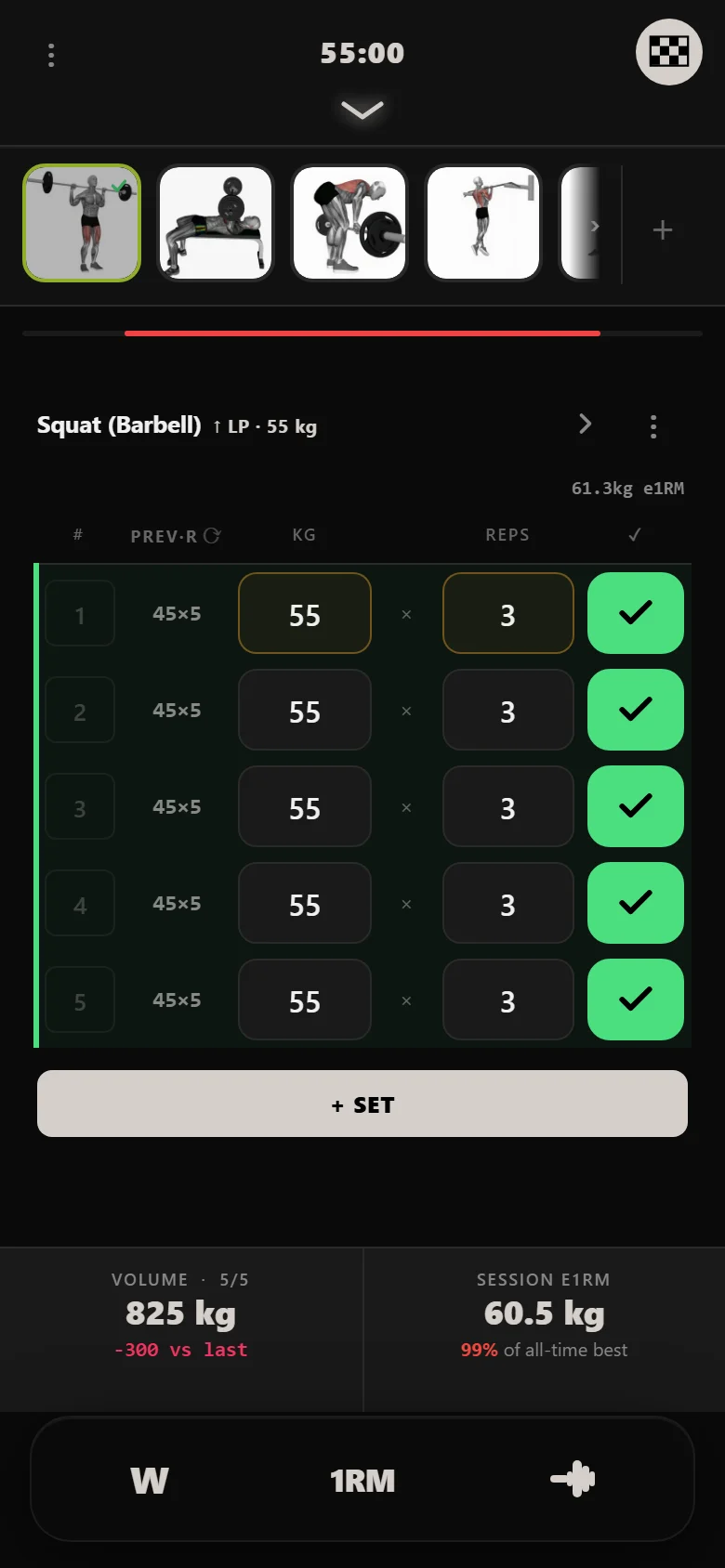
At 55 kg the wheels come off. Five sets are prescribed at five reps and only three reps go up — a genuinely failed session. This is the moment that matters, because the obvious mistake is for an app to look at the heaviest set you logged, see a completed set at 55 kg, and add weight anyway.
DropSet holds. The weight stays at 55 kg for the next session, and the one after that, because the target was five reps on every working set and three of them fell short. Nothing advances on a session you didn't complete.
Look at the two numbers at the bottom of that screen: PREV reads 55 × 3, and volume reads 0 vs last. That's the stall stated plainly — you have just repeated the previous session exactly, because the weight didn't move and neither did the reps. Three of those in a row is the app's cue to act.
The deload — the app backs you off
Three missed sessions in a row trips the rule, and the app drops the squat by 10% — 55 kg becomes 50 kg — then restarts the climb from there. You didn't decide that, calculate it, or remember to do it. The program specifies a deload after three failures and the engine applied one.
Here is the part people get wrong about deloading: it isn't lost ground, it's a run-up. Six weeks of squatting — eighteen sessions, not eighteen weeks — look like this. Six decisions to add weight, three to hold it, one to cut it by 10%, and then a rebuild that carries you straight back through the weight that stopped you. By session 12 you're back at 55 kg. By session 13 you're past it, and you finish with 70 kg on the bar — 15 kg above the ceiling that beat you, and 72.5 kg already prescribed for the next session.
Squat — weight on the bar, per session (3 sessions a week)
- 40S1 Session 1
- 42.5S2 Session 2
- 45S3 Session 3
- 47.5S4 Session 4
- 50S5 Session 5
- 52.5S6 Session 6
- 55S7 Session 7 — 55×3 — missed, weight held
- 55S8 Session 8 — 55×3 — missed, weight held
- 55S9 Session 9 — third miss trips the deload
- 50S10 Session 10 — −10% applied automatically
- 52.5S11 Session 11
- 55S12 Session 12 — back at the weight that stalled it
- 57.5S13 Session 13 — past the old ceiling
- 60S14 Session 14
- 62.5S15 Session 15
- 65S16 Session 16
- 67.5S17 Session 17
- 70S18 Session 18 — 15 kg above the stall — 72.5 prescribed next
The accessories run a different rule entirely
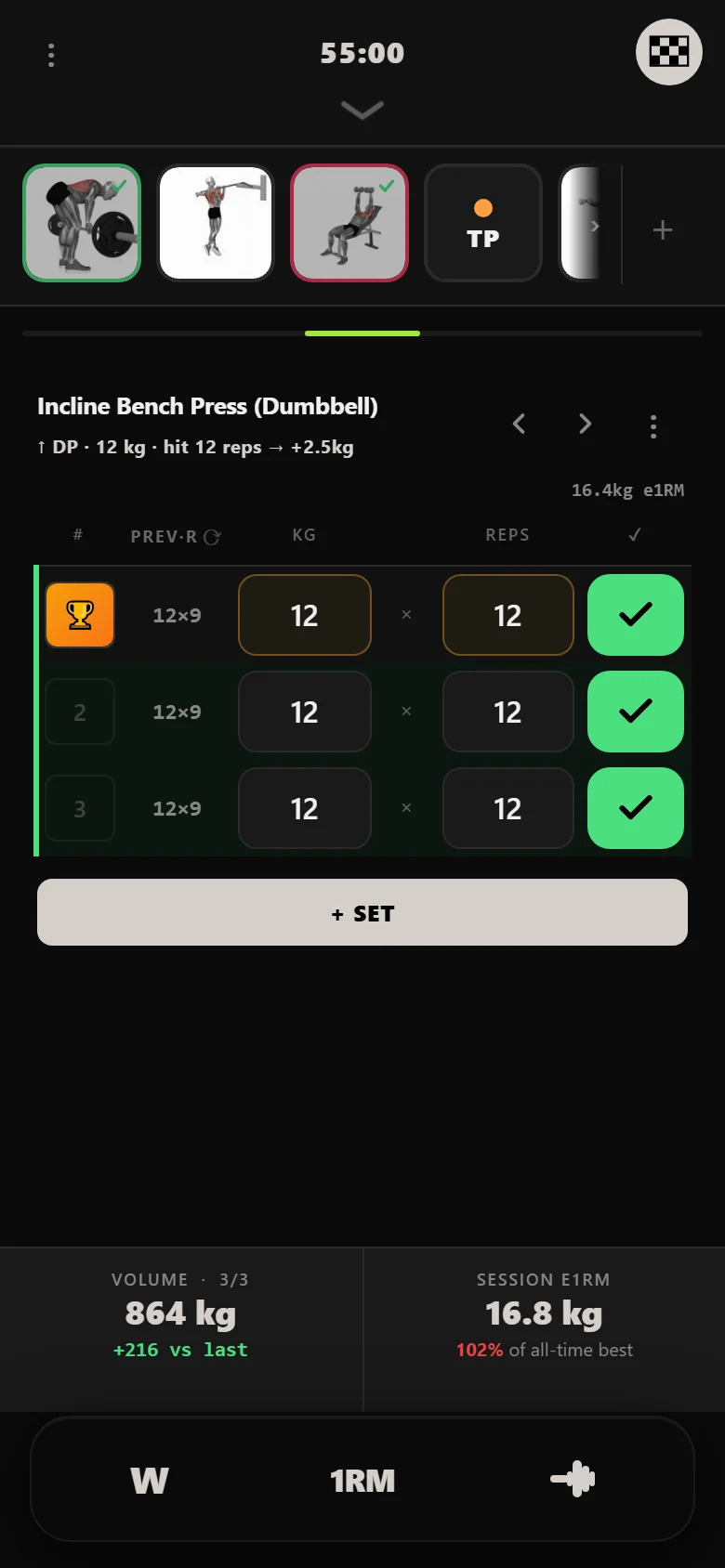
The compounds run linear progression. The accessories don't — they run double progression, and both rules are live in the same session. On double progression the weight is fixed and you chase reps inside a range first: 8, then 9, then 10, then 11, at the same weight. Only when every set reaches the top of the range does the weight go up.
The chip spells the rule out in place — "↑ DP · 12 kg · hit 12 reps → +2.5kg" — so you know what the session is asking of you before you start it. Hit 12 on all three sets and the next session is heavier, back at the bottom of the range.
The prescribed range never changes: it stays 8–12 for as long as you run the program. What moves is the weight. And reps inside the range are not a failure — grinding out 9 where you managed 8 last time is progress, so the app holds the weight and lets you keep climbing rather than counting it against you.
What it looks like afterwards
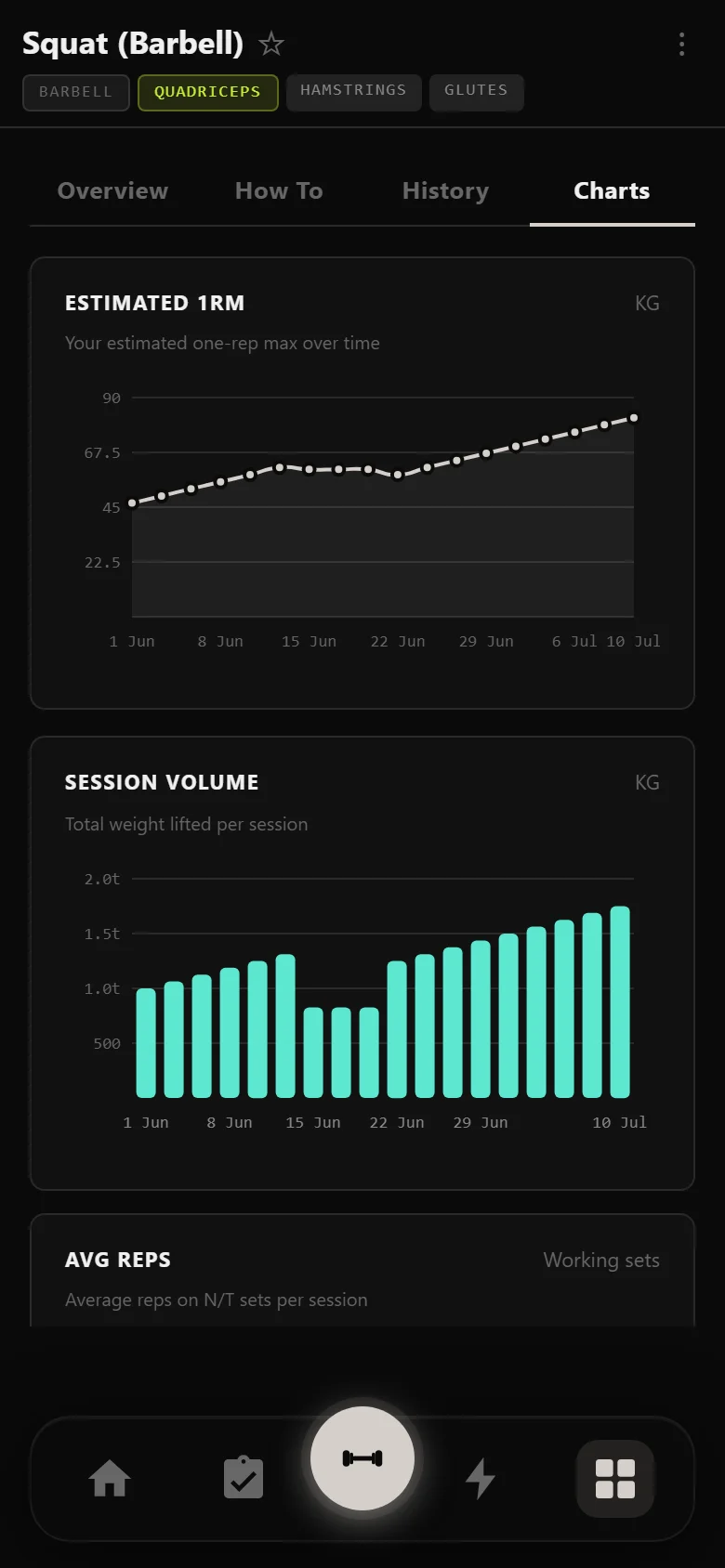
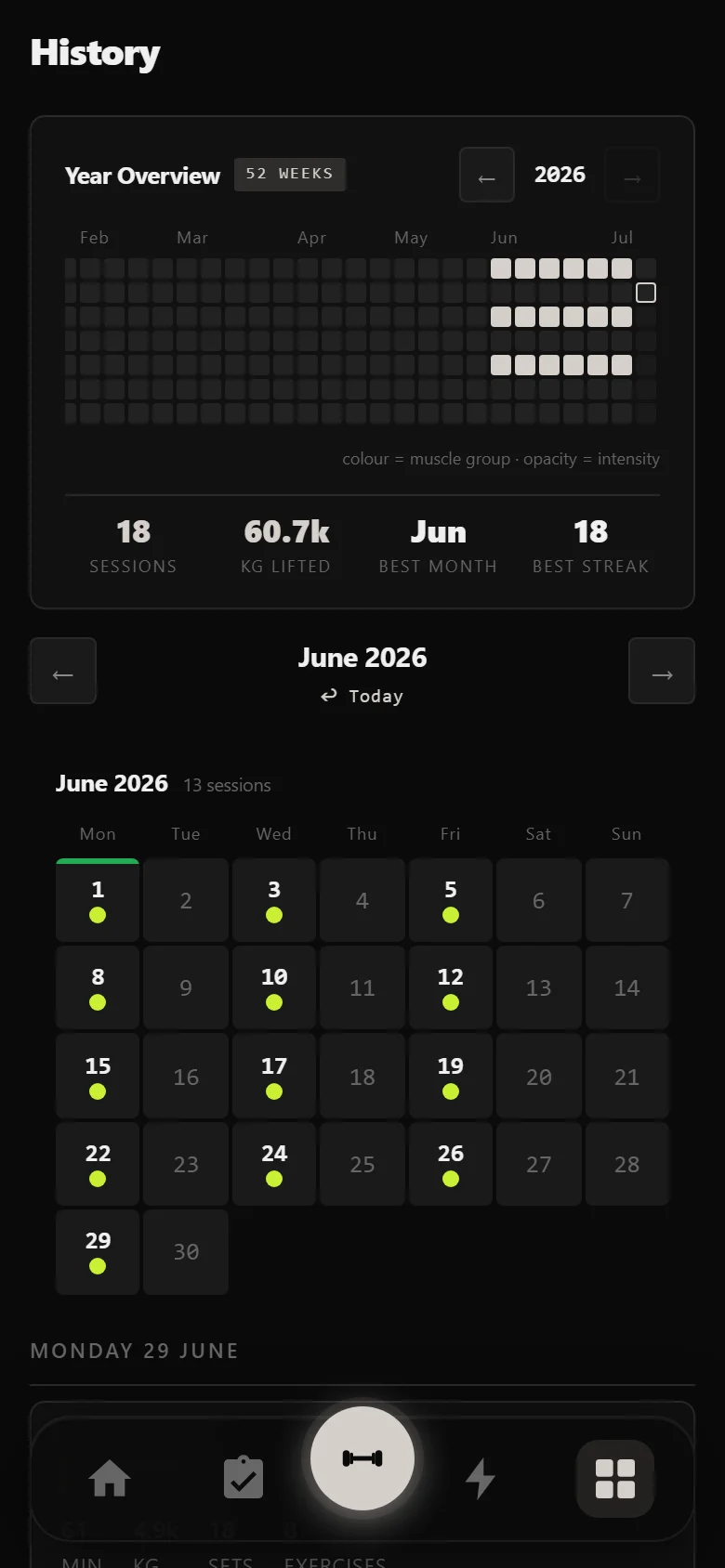
Eighteen sessions across six weeks fill the History calendar from the start date, and the squat's own Estimated 1RM chart draws the shape of the block: a straight climb, a flat stretch where the weight held, the dip at the deload, then a longer climb through the old ceiling. That sawtooth is what linear progression actually looks like once you train long enough to stall — the honest picture, not a line that only goes up.
The session-volume chart underneath tells the same story from the other side: bars stepping up, three short bars through the stall, then a taller run than before. Six weeks of training, no spreadsheet.
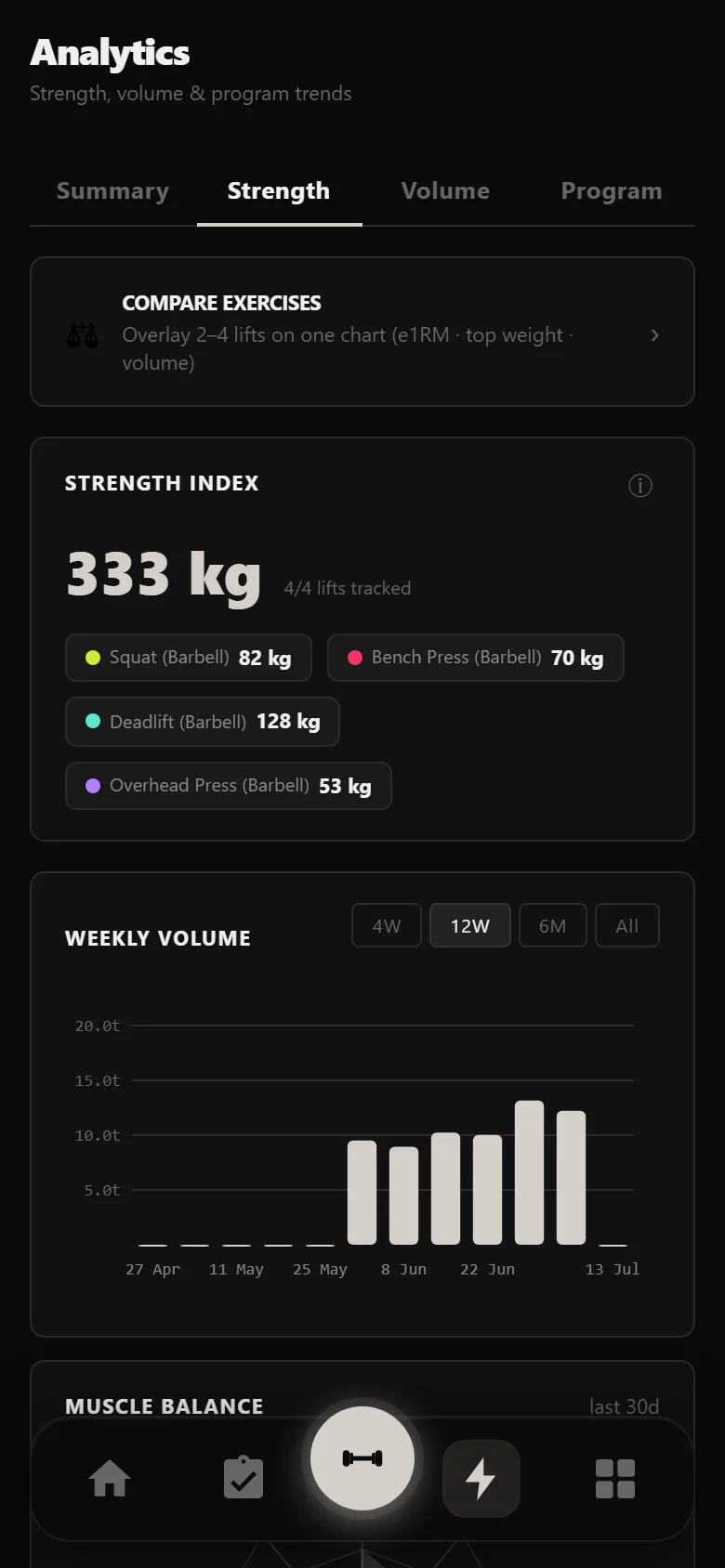
The payoff — where the squat started and finished
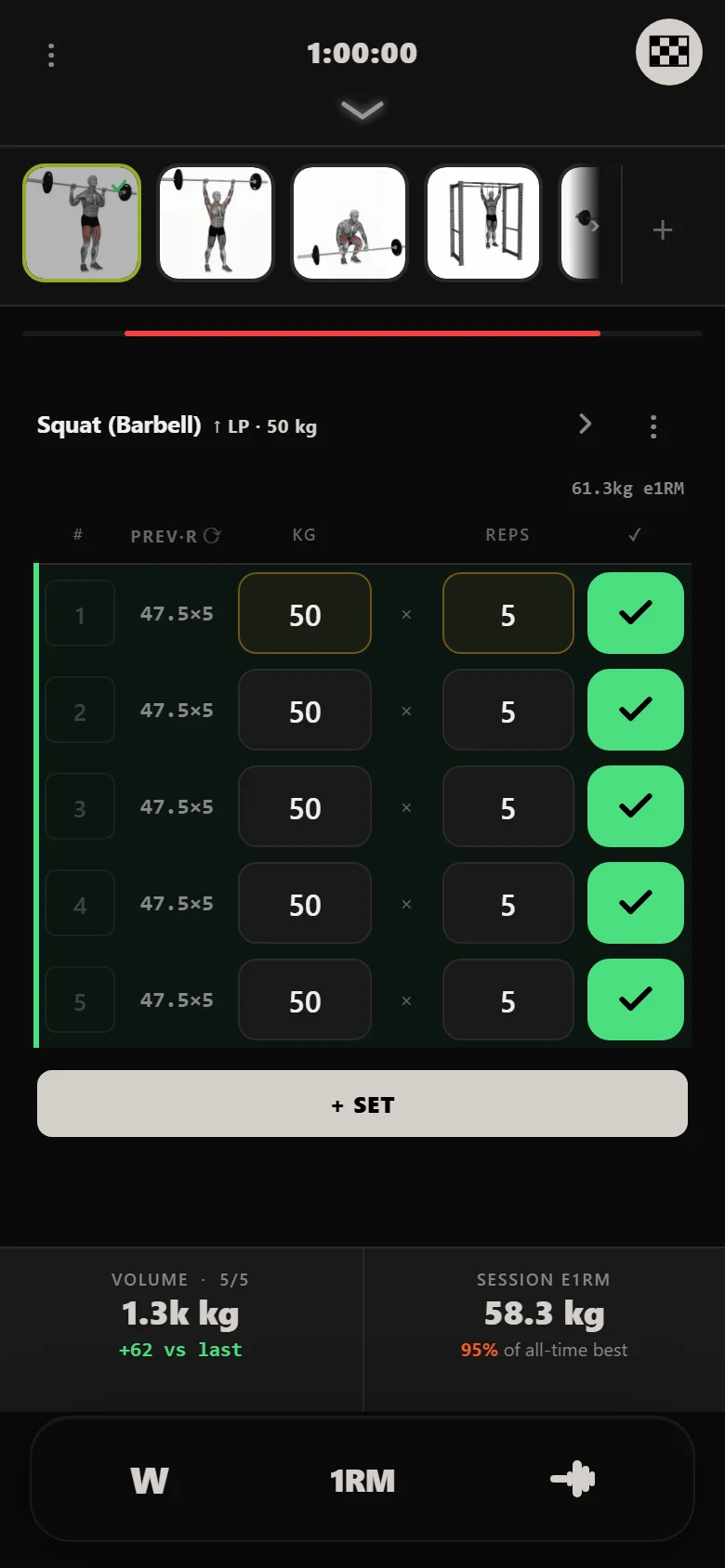
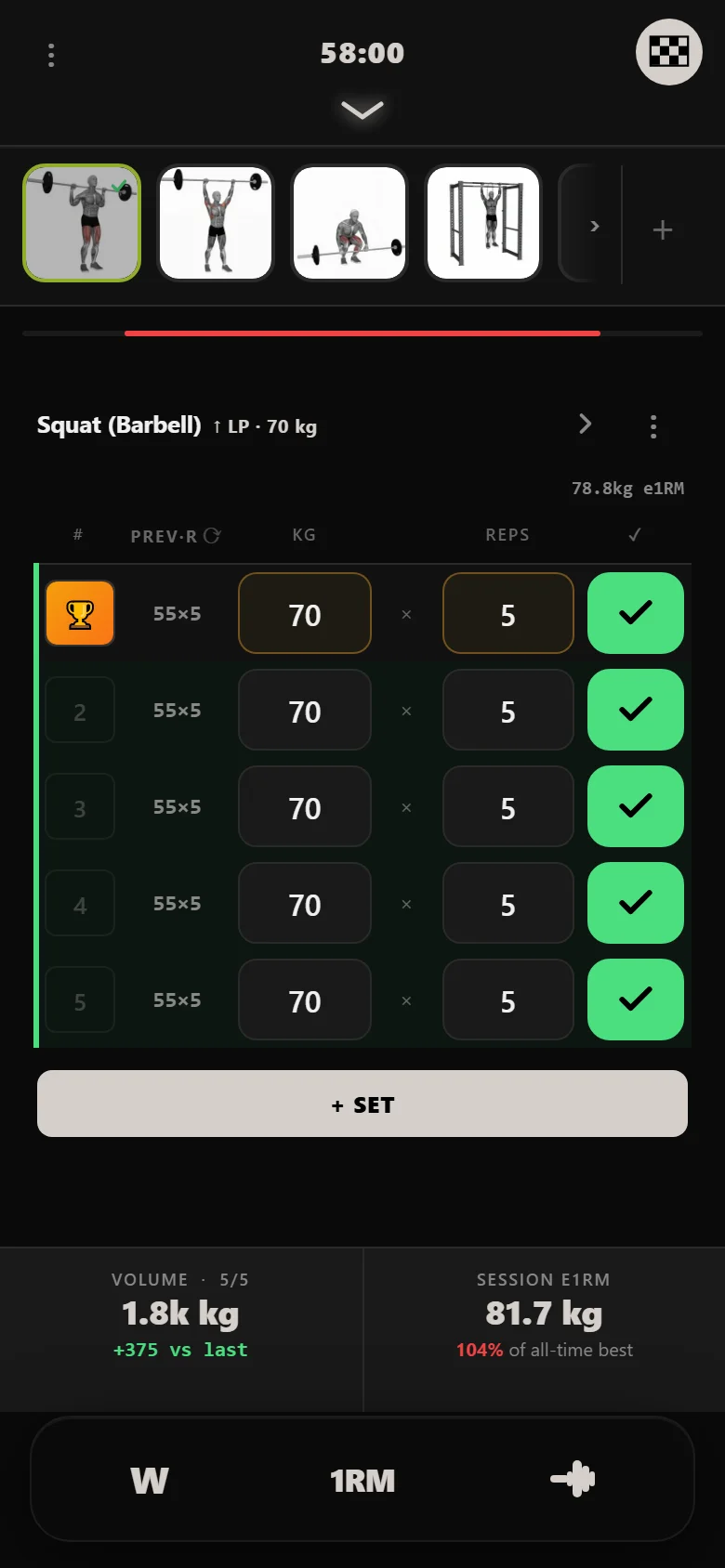
Two screenshots of the same squat, six weeks apart: the same five sets of five, the same lift, the same screen. Session one opened at 40 kg; the later shot has 70 kg on the bar, after a full stall at 55 kg, an automatic deload to 50, and a rebuild straight back through the ceiling. Nothing in between was typed in — every weight was decided by the engine from the sets that were logged. That is the case for the app in one screen.
Same squat, six weeks apart — 40 kg opener to 70 kg on the bar, with 72.5 kg prescribed next. The stall and the deload are in between, and the app drove every weight.
Common questions
What is linear progression?
The simplest progression there is: add a small fixed amount of weight every session for as long as you can complete the prescribed sets and reps. On this program the squat, bench, row and overhead press all run 5×5 and go up 2.5 kg a session. The deadlift is the exception: one work set of five, and 5 kg a session — it's the strongest lift and it recovers slowest, so it gets less volume and a bigger jump.
What weight should I start with?
Less than you think. Linear progression works because you can add weight for months, so starting light is the whole point rather than a compromise — this run opens at a 40 kg squat and finishes six weeks later with 70 kg on the bar. Pick a weight you can complete all five sets with comfortably and let the app do the adding.
What counts as a failed session?
Missing the rep target on any working set. All five sets at five reps is a success; 5, 5, 5, 5, 3 is a miss, and the weight holds. DropSet judges every working set on a straight-sets scheme, not just the heaviest one — otherwise a session you clearly didn't complete would still add weight.
What happens when I stall?
The weight stays where it is. If you miss the number of sessions the program specifies in a row — three, here — DropSet reduces the weight by the deload percentage the program specifies (10%) and the climb restarts from there. You don't have to notice the stall or work out the new number.
Isn't a deload going backwards?
Only if you stop. The reduced weight is a run-up: you climb back through the weight that stalled you with a few more weeks of training behind you. In this block the squat stalled at 55 kg, deloaded to 50 kg, was back at 55 kg by session 12 and finished with 70 kg on the bar.
What is double progression?
A rule for work prescribed in a rep range, like 8–12. The weight stays fixed while you add reps session to session; once every set reaches the top of the range, the weight goes up and you start again at the bottom. The range itself never changes — only the load does.
Do reps inside the range count as a failure?
No. If the range is 8–12 and you hit 9, that's progress, and the weight holds so you can keep climbing. Only dropping below the bottom of the range counts against you — and if that happens for as many sessions as the program specifies, the weight deloads just like the compounds.
Is DropSet free?
Yes — DropSet is free during beta, with the full program catalogue, automatic progression maths, rest timers and PR tracking. Everything in this walkthrough is in the app.
Put it into practice
DropSet is free during beta — 50 proven programs, automatic progression, rest timers and PR tracking, all on your phone.