Starting a program: training maxes and schedule
When you start a program, DropSet runs a short one-time setup so it can put the right weight on the bar from your very first session. For a percentage-based program like 5/3/1 that means asking for your training maxes; for its accessory lifts it asks the weight you want to start at; and for any program it offers to schedule a start date. It takes under a minute, and this guide explains each step so none of it is a surprise.
If a program uses only simple linear progression — add a bit each session — you'll see just the starting-weights step and the start date. The training-max step only appears for programs that are actually driven by training maxes.
Last reviewed 2026-07-17 · matches app v0.9.0.54
Setting your training maxes
A training max (TM) is a working number your program's percentages are calculated from — deliberately a little below your true one-rep max, so the prescribed weights stay makeable week after week. Percentage programs are built around it: a set written as '85%' means 85% of your training max, not 85% of an all-out max. Using a slightly conservative TM is the whole point — it keeps the weights heavy enough to progress but light enough that you don't miss reps and stall.
When you start a TM-based program, DropSet shows a sheet with a row for each main lift and suggests a training max for you, estimated from your logged history — typically around 90% of your best estimated one-rep max (a few programs use 100%, and DropSet knows which). If you've no history for a lift, you enter the number yourself. Don't overthink it: err low. A TM that's too light costs you a week or two; one that's too heavy stalls the whole program.
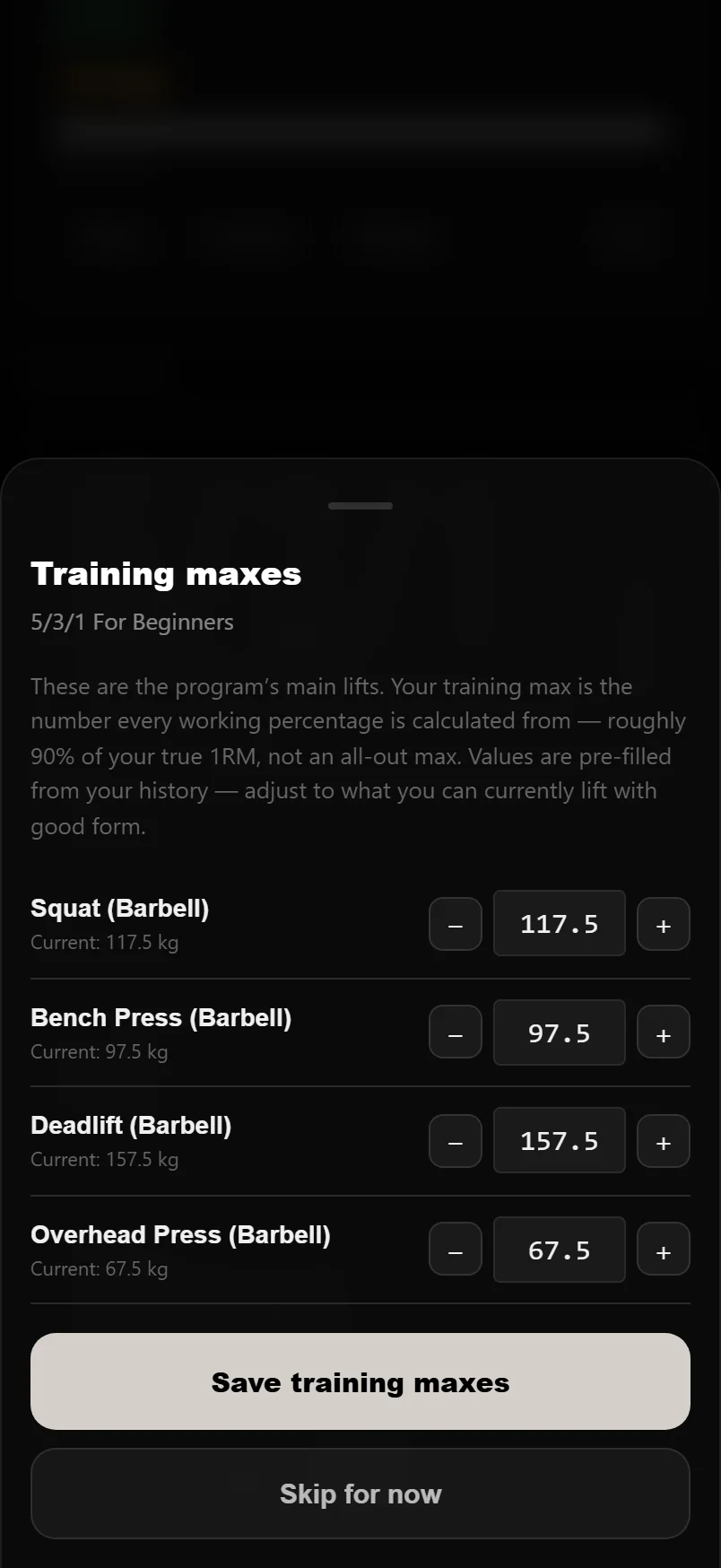
Your training max is not your one-rep max. If in doubt, set it to a weight you could do for a clean set of 5 today — you want the program to feel repeatable, not maximal.
Choosing your accessory weights
After the training maxes, DropSet asks for the weight you'll start each accessory lift at — the supporting exercises that aren't driven by a training max. Where you have logged history, it estimates a sensible starting weight for the program's target reps; where you don't, you can enter one or leave it blank and set it on the day. Your main lifts are already handled by the training maxes you just set, so this step is only about the accessories.
As with the training max, starting a touch conservative is the smart move. Accessories are there to add volume and build muscle, not to be maxed out — pick weights you can complete with good form for all the prescribed sets, and let them climb over the weeks.
AMRAP sets and how your training max grows
Many percentage programs finish a main lift with an AMRAP set — 'as many reps as possible'. It's the last set at the day's top weight, and instead of a fixed number you do as many good reps as you can. This does two jobs: it's the hard, productive set that drives the adaptation, and it's the test the program uses to decide whether you've earned more weight.
In DropSet, hitting the AMRAP target is what raises your training max for the next cycle. Beat the minimum reps and the app bumps that lift's TM — a small, automatic increase — so next cycle's percentages are calculated off a slightly heavier number. Miss it, and the TM holds so you can consolidate. That's the engine of a TM program: the AMRAP set earns the increase, and the training max carries it forward. You never work out the next jump yourself.
Leave a rep or two in reserve on AMRAP sets rather than grinding to absolute failure — you'll still trigger the progression, recover better, and keep the next session productive. See our RPE and RIR guide.
Scheduling a start date
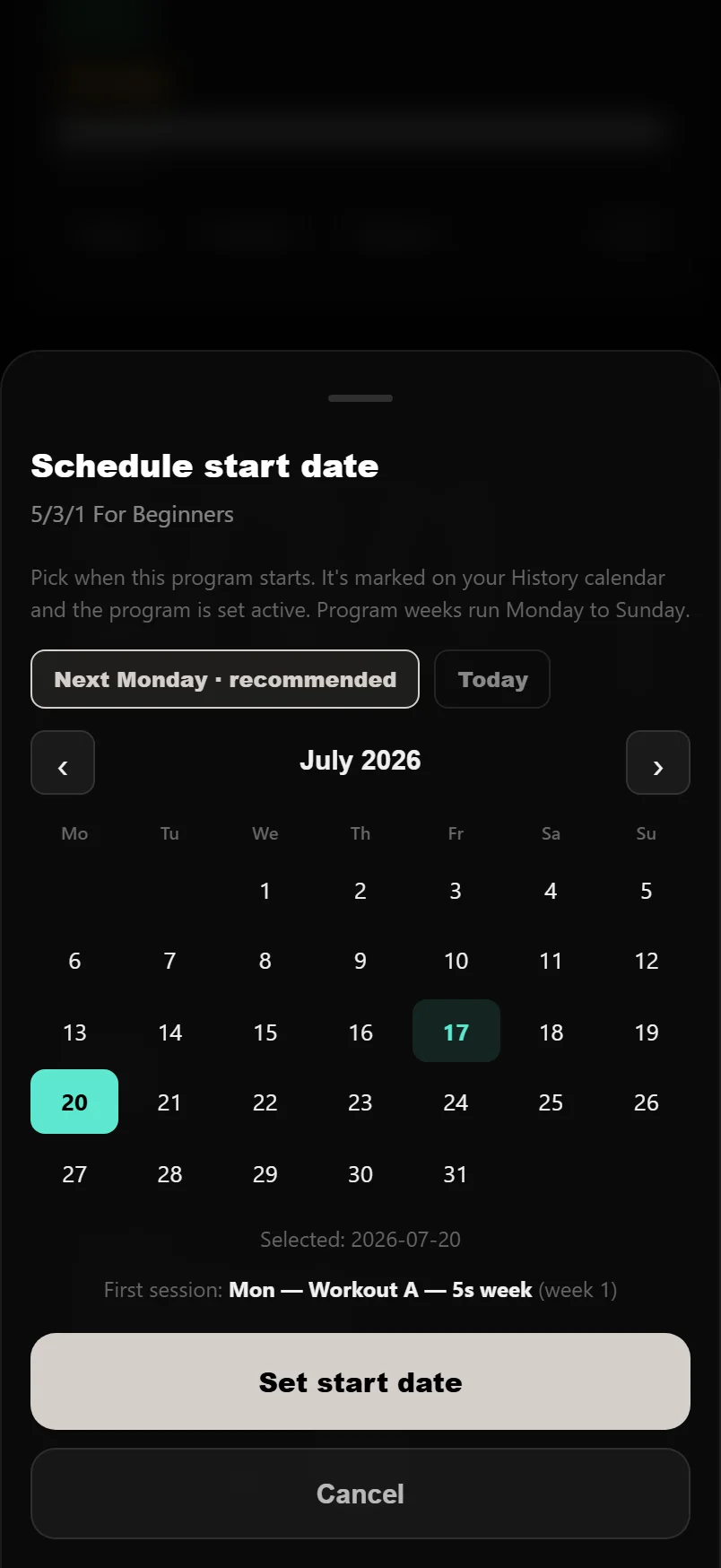
Finally, DropSet offers to schedule when the program begins, and it recommends next Monday by default. Program weeks run Monday to Sunday, so starting on a Monday lines your training week up cleanly with the program's — which is why it's the suggested option, one tap away. You can take that recommendation, start today instead, or pick any date on the calendar. Whatever you choose is marked on your History calendar and the program is set active, and the sheet shows you exactly which session you'll begin with.
The start date isn't set in stone. You can change it later from the program's menu, and restarting a program resets its schedule while keeping your training maxes and logged history. So take the Monday nudge or pick your own day to get going — the program activates, your first session appears, and you can adjust the timing whenever you need.
Common questions
What is a training max?
A working number your program's percentages are calculated from, set a little below your true one-rep max so the prescribed weights stay makeable every week. A set written as '85%' means 85% of your training max. Keeping it slightly conservative is what stops you stalling.
How does DropSet set my training max?
When you start a training-max program it suggests one per lift, estimated from your logged history — usually around 90% of your best estimated one-rep max (some programs use 100%, and DropSet knows which). If you have no history for a lift, you enter it yourself. When in doubt, set it low.
What does AMRAP mean?
'As many reps as possible' — the last set at the day's top weight, where you do as many good reps as you can instead of a fixed number. In a training-max program, beating the AMRAP target is what earns an automatic increase to that lift's training max for the next cycle.
Do I have to set my weights when I start a program?
Only briefly. Training-max programs ask for your training maxes and accessory starting weights up front so the first session is ready to go; simpler programs just ask a starting weight. DropSet estimates from your history where it can, and you can leave anything blank to set on the day.
Can I change my program's start date?
Yes — set a start date when you begin, then change it any time from the program's menu. Restarting a program resets its schedule while keeping your training maxes and logged history, so you can re-time it without losing progress.
Put it into practice
DropSet is free during beta — 50 proven programs, automatic progression, rest timers and PR tracking, all on your phone.